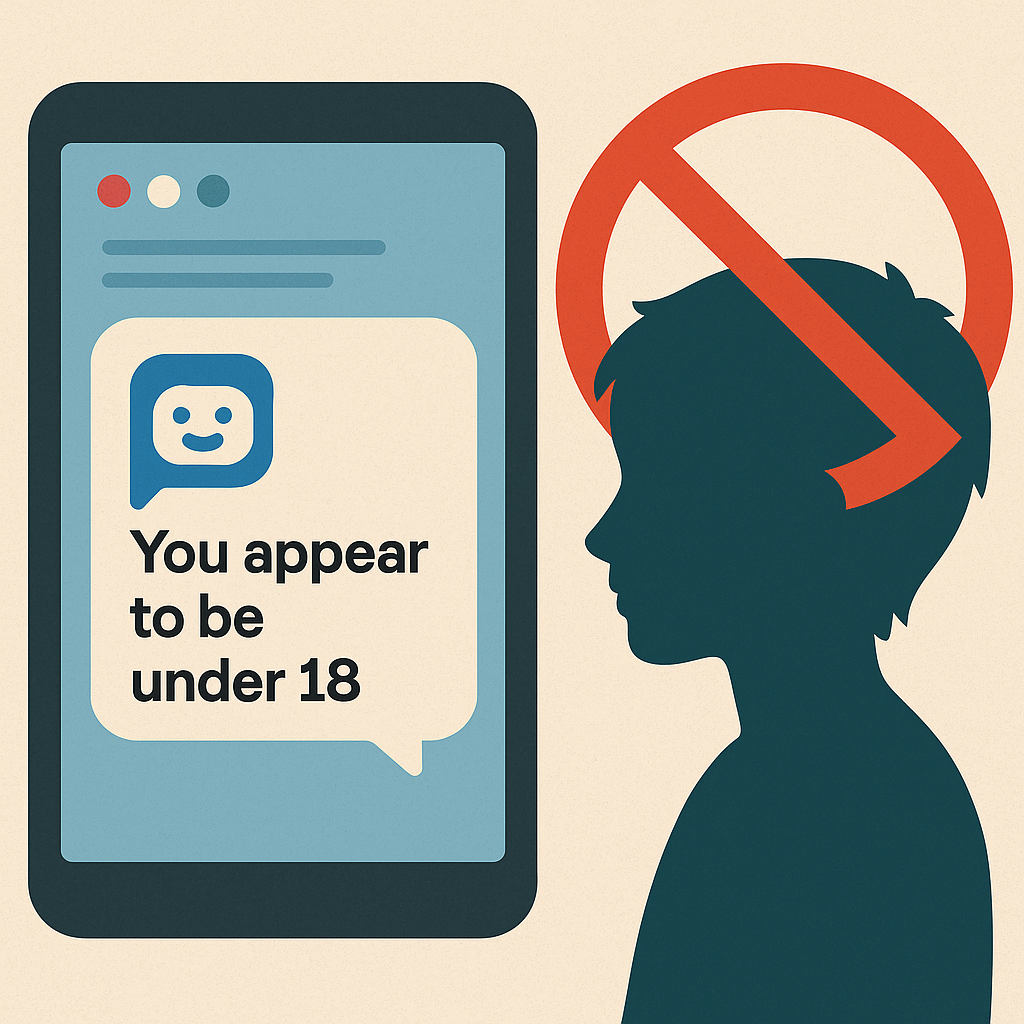
OpenAI Implements AI-Powered Age Estimation to Enhance Youth Safety
Imagine opening ChatGPT and asking:
“Based on everything you know about me, how old do you think I am? If you aren’t sure, estimate.”
Soon, the answer to that question could influence how the AI responds to you. OpenAI has announced it is developing an AI-powered age-estimation system to better protect younger users.
Rather than requiring identification, the system will predict whether a user is likely under 18 based on conversational patterns. If ChatGPT believes a user is a teen, it will automatically apply stricter safety rules, such as blocking explicit content or restricting sensitive topics.
OpenAI has also stated that in some regions or under certain regulations, users may be asked to verify their age with official identification, but this will not be a universal requirement. The company’s goal is to balance youth safety with privacy and accessibility.
OpenAI emphasizes the difference between age estimation and age verification.
- Age estimation uses AI to predict a user’s age group from their conversations. It is seamless, does not block access, and does not require official documents.
- Age verification requires users to confirm their age with government-issued identification, such as a driver’s licence or passport.
The new system relies primarily on age estimation, automatically activating stricter safeguards when a user appears to be under 18. This differs from traditional age-verification systems that act as hard barriers, which OpenAI says it aims to avoid unless local regulations demand it.
OpenAI’s announcement comes at a time of increasing public concern and regulatory pressure.
The death of 16-year-old Adam Raine in April 2025 drew widespread attention to the potential risks of teens interacting with AI chatbots. While the exact circumstances remain under investigation, his case has intensified calls for stronger youth protections and clearer safety measures for AI tools.
Regulators are also stepping up enforcement. In December 2024, Italy fined OpenAI €15 million for violations of GDPR privacy rules. Italy was the first Western country to temporarily ban ChatGPT in March 2023, citing privacy and data protection concerns. OpenAI has announced plans to appeal the fine, while continuing to improve its compliance with European privacy laws.
These events highlight the growing global demand for AI companies to demonstrate accountability and responsibility when handling sensitive data and vulnerable users.
| Feature | Details |
|---|---|
| Age-estimation model | Uses conversational cues to predict whether a user is likely under or over 18. |
| Under-18 experience | Automatically applies stricter filters, blocking explicit sexual content, limiting flirtatious conversations, and restricting discussions of self-harm or suicide. |
| Parental controls | Rolling out over the coming month (late September through October 2025). These tools will allow parents or guardians to manage and monitor teen accounts. Full details have not yet been disclosed. |
OpenAI acknowledges that this system will not be perfect. There is a risk of misclassification, where adults may be mistakenly treated as teens or minors may go undetected. When the system is uncertain, it will default to the safer, restricted experience.
Accuracy: AI predictions can be wrong, frustrating adults whose access is limited or leaving gaps in protection for minors.
Privacy: The system relies on analyzing conversations to estimate age, raising questions about how that data is processed, secured, and stored. Under Canadian law, such as the Personal Information Protection and Electronic Documents Act (PIPEDA), this type of data use must be transparent and privacy-protective. The Office of the Privacy Commissioner (OPC) has stated that age-assurance methods can be done “in a privacy-protective and sufficiently accurate manner” when properly designed.
Bias: Cultural, linguistic, and demographic differences could cause the model to misinterpret language patterns, leading to inconsistent results.
Regulatory complexity: Different countries have different privacy and safety rules, requiring OpenAI to adapt its rollout to a wide range of legal frameworks, especially in Europe and North America.
OpenAI says it processes data on servers located in multiple jurisdictions with safeguards designed to meet local privacy laws. The company stresses that its goal is to protect young users without unnecessarily collecting personal information, using AI-based estimation as a middle ground between safety and privacy.
In Canada, privacy laws such as PIPEDA require companies to handle personal information transparently and securely. Even though OpenAI’s approach avoids collecting government IDs for most users, it still involves using conversational data to infer age.
Canadian regulators will be watching closely to ensure that these systems are both accurate and privacy-protective, especially for youth. The Office of the Privacy Commissioner has emphasized that any age-related data processing must be limited, secure, and accompanied by clear consent mechanisms.
OpenAI’s age-estimation initiative represents a significant step in AI safety. By moving away from self-reported ages and avoiding broad, mandatory ID checks, the company is attempting to balance protecting younger users with respecting privacy and accessibility.
As regulatory pressure grows and public expectations increase, systems like this will likely become standard across major technology platforms. The rollout over the coming month will be closely watched as a test case for how AI companies address one of the most pressing challenges in the industry: keeping young users safe while maintaining trust and transparency.