Lithium Batteries at 35,000 Feet: What Really Changed in the Past Year
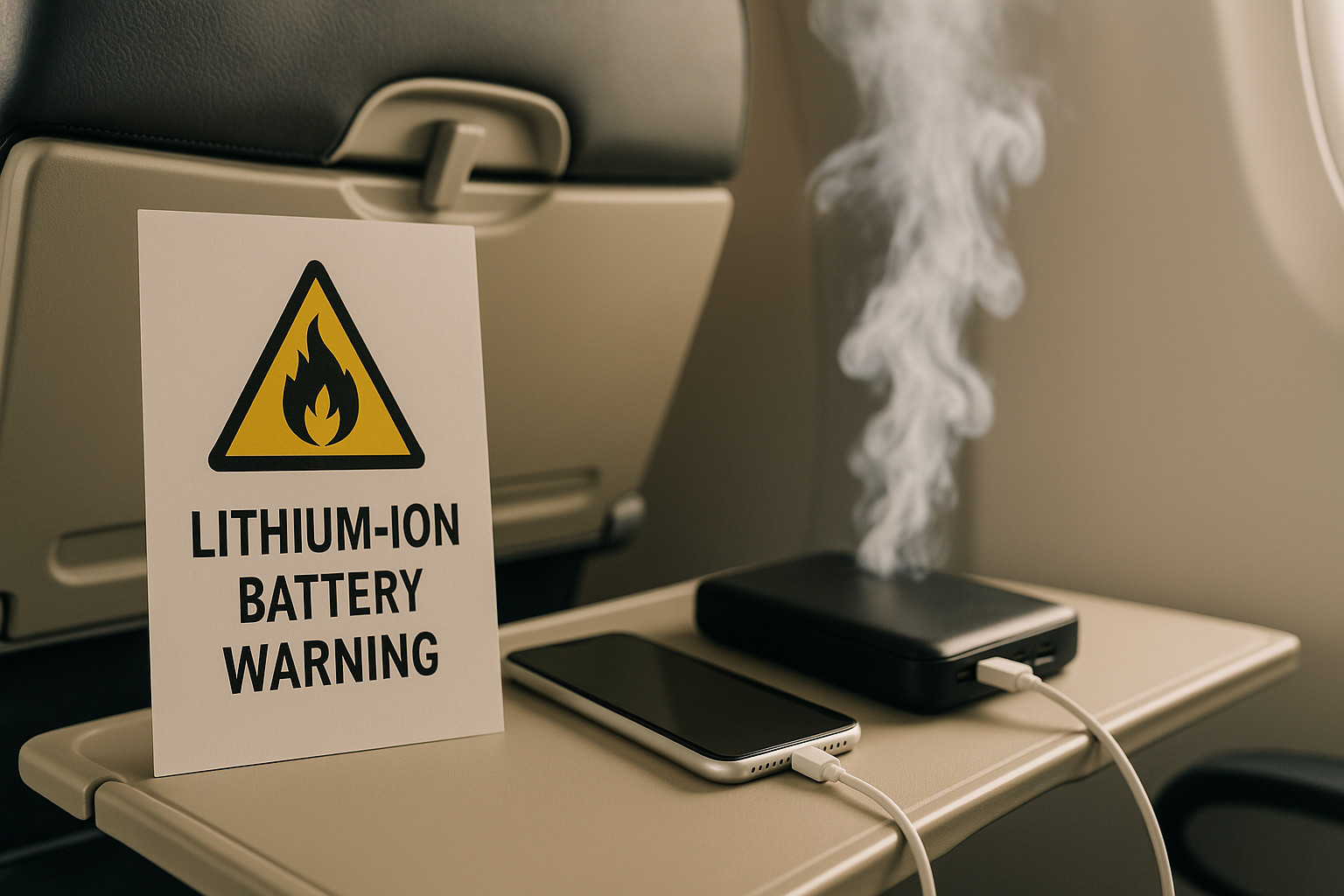
Airlines have lived with lithium batteries for years. They power every phone, laptop and tablet on board. But when they fail, they overheat and burn in ways that are difficult to control in a confined cabin. Recent data and a string of high-profile incidents show this is no longer a theoretical risk.
The portable devices travellers carry onto planes every day have become an unexpected safety hazard in commercial aviation. Lithium-ion battery incidents have reached record levels, prompting airlines worldwide to implement unprecedented restrictions and forcing travellers to reconsider how they pack and use their electronic devices.
The Problem Is Getting Worse
The U.S. Federal Aviation Administration recorded 89 lithium battery incidents involving smoke, fire or extreme heat on aircraft in 2024 — the highest annual total since tracking began in 2006. Through August 2025, the FAA documented 50 verified incidents, averaging two thermal runaway events per week.
This represents a 388-per-cent increase since 2015, when only 16 such incidents were recorded. Since March 2006, the FAA has logged 644 lithium battery-related incidents, with portable chargers alone causing nearly 40 per cent of all events.
UL Standards and Engagement, which tracks data from 37 passenger and cargo airlines, reported a 15-per-cent increase in battery thermal runaway incidents over the past five years. Nearly one in five incidents results in flight diversions, emergency evacuations or returns to the gate.
When Batteries Fail in Flight
The high-profile events from the past year are not outliers. They reveal a pattern: the incidents that worry airlines most are starting not in cargo holds, but in passenger cabins, often in bags stored overhead.
On Jan. 28, 2025, an Air Busan Airbus A321 at Gimhae International Airport in Busan, South Korea, was destroyed after a fire began in an overhead luggage bin. All 176 people aboard — 169 passengers and seven crew members — evacuated using emergency slides. Twenty-seven people were injured, including four crew members who experienced smoke inhalation and three elderly passengers who suffered back injuries during the evacuation.
The fire started at approximately 10:26 p.m. local time as the aircraft prepared to taxi. Passengers reported hearing a “crackling” sound before flames erupted. The blaze spread rapidly through the tail section and consumed nearly half the fuselage. Photos from the scene showed the aircraft’s roof completely burned off.
On March 14, 2025, South Korea’s transport ministry released preliminary findings: a portable power bank stored in an overhead compartment was the likely cause. Investigators found scorch marks on power bank debris and concluded the fire started when insulation inside the battery broke down, triggering thermal runaway. The incident prompted immediate regulatory changes across Asia.
Other notable incidents in 2025 include an Air China flight from Hangzhou to Seoul that diverted in October 2024 after a lithium battery in overhead luggage ignited, an American Airlines flight from Dallas to Madrid that diverted in August after a passenger’s cellphone overheated, and a United Airlines flight from Chicago to Portland that diverted to Casper, Wyo., in July after a laptop began smoking.
Which Batteries Cause the Most Problems
Power banks and external battery packs represent the single largest category in recent cabin incidents. According to FAA data from 2006 to September 2025:
- Power banks and battery packs: 230 incidents (39 per cent)
- E-cigarettes and vaping devices: 123 incidents (21 per cent)
- Cellular phones: 83 incidents (14 per cent)
- Laptops: 72 incidents (12 per cent)
UL Standards & Engagement’s analysis of incidents in 2024 found a similar pattern, with vaping devices accounting for 28 per cent of incidents, power banks for 19 per cent, cellphones for 18 per cent and laptops for 15 per cent.
Power banks pose particular risks because many are manufactured as inexpensive consumer products with low-quality battery cells, minimal thermal management systems and poor safety circuitry. The Air Busan, Air China and American Airlines incidents all involved power banks or phone batteries in carry-on bags. When a battery pack fails in an overhead compartment, crew may not see smoke until the fire is well-developed.
Why Lithium Batteries Are Dangerous
Lithium-ion batteries pack substantial energy into small spaces, making them useful but dangerous when they fail. Thermal runaway occurs when heat generation within a battery cell exceeds its ability to dissipate that heat. Temperature rises rapidly, flammable gases vent, and the battery can burn or explode. The process can escalate within seconds, reaching temperatures exceeding 500 degrees Celsius.
What Triggers Failure
Physical damage: Crushing, puncturing or excessive vibration can rupture the thin separator between electrodes, creating an internal short circuit that generates immediate heat.
Electrical abuse: Overcharging by five per cent increases battery decay rates threefold, according to laboratory data. Overcharging by 10 per cent causes thermal runaway risk to increase exponentially.
Temperature extremes: Exposure above 60 C or below 0 C initiates thermal instability. High temperatures reduce a battery’s ability to dissipate heat.
Manufacturing defects: Microscopic metal particles from production can penetrate the separator, causing short circuits. Poor quality control makes batteries prone to failure during normal use.
Age and wear: Repeated charge cycles degrade internal materials and reduce heat tolerance, making older batteries increasingly unstable.
The Challenge of Battery Fires
When thermal runaway begins, batteries release flammable gases and can reignite even after flames are suppressed with halon fire extinguishers. The FAA recommends flight attendants follow halon with large quantities of water or non-alcoholic liquids to cool the battery.
Fires also produce toxic gases including hydrogen fluoride, hydrogen cyanide and carbon monoxide. Near a thermal runaway event, hydrogen fluoride concentrations can reach hundreds of parts per million and carbon monoxide can reach percentage-level concentrations — both far above safe exposure limits.
How Aviation Rules Are Changing
The Baseline That Hasn’t Changed
The International Civil Aviation Organization sets technical standards for air transport of lithium batteries, implemented through the International Air Transport Association’s Dangerous Goods Regulations. For passengers, the key points — reflected in Transport Canada and Canadian Air Transport Security Authority guidance — have remained consistent:
- Lithium batteries are classified as dangerous goods
- Power banks and spare lithium batteries are never allowed in checked baggage; they must travel in carry-on bags with terminals protected against short circuits
- Small consumer batteries (up to 100 watt-hours) installed in devices are permitted in both carry-on and checked baggage, though regulators strongly encourage keeping them in the cabin
- Larger batteries (100 to 160 watt-hours) require airline approval and are limited in number
- Batteries above 160 watt-hours are prohibited in passenger baggage
- Damaged, defective or recalled lithium batteries are prohibited on passenger aircraft
Transport Canada reinforces this in plain language for Canadian travellers: keep lithium batteries in carry-on bags wherever possible, never pack spare batteries in checked luggage, and do not travel with damaged, swollen or recalled cells.
What Changed in 2025
Although the IATA dangerous-goods standard has not been revised, regulators and airlines have layered on additional restrictions in direct response to the spike in power bank incidents.
South Korea: After the Air Busan fire, the Ministry of Land, Infrastructure and Transport introduced rules effective March 1 requiring passengers to keep power banks and e-cigarettes on their person rather than in overhead bins. Charging devices in flight is prohibited, and passengers are limited to five power banks.
Hong Kong: The Civil Aviation Department ordered that from April 7, passengers may not use or charge power banks during flights or store them in overhead lockers. Cathay Pacific, HK Express and Hong Kong Airlines implemented these rules.
United States: Southwest Airlines became the first major U.S. carrier to require that portable charging devices must be visible when in use, rather than operating inside bags in overhead bins. The FAA issued a safety alert in 2025 reminding airlines to reinforce training around passenger lithium battery risks.
Singapore: Effective April 1, passengers are prohibited from charging power banks using onboard USB ports or using power banks to charge personal devices during flight.
Thailand: Thai Airways banned the use and charging of power banks during flights starting March 15.
Taiwan: EVA Air and China Airlines banned the use of lithium power banks and spare batteries onboard aircraft effective March 1.
Malaysia: AirAsia requires passengers to store power banks under the seat or in the seat pocket, prohibits charging devices during flight, and limits passengers to power banks under 100 watt-hours (20,000 milliampere-hours). Batteries between 100 and 160 watt-hours require airline approval at check-in.
The pattern is clear: the international baseline has stayed steady, but regulators and airlines have tightened operating rules by banning in-flight use of power banks, forbidding storage in overhead bins, requiring visible use, and setting additional certification requirements.
Airlines Implement Stricter Power Bank Policies
In response to the rising incident rate and the Air Busan catastrophe, airlines worldwide have introduced new restrictions on lithium battery usage during flights.
United States Airlines
Southwest Airlines became the first United States carrier to update its policy in May 2025, requiring passengers to keep portable chargers and power banks in plain sight when in use during flights. The airline’s policy states that when a portable charger or power bank is used during a flight, it must be out of any baggage and remain in plain sight. Passengers are explicitly instructed not to charge devices in the overhead bin. This groundbreaking policy set a precedent for other carriers.
Middle East Airlines
Emirates implemented the most comprehensive restrictions effective October 1, 2025, prohibiting the use of any power bank aboard its flights. Passengers may carry one power bank under 100 watt-hours, but cannot use it to charge devices or recharge the power bank using the aircraft’s power supply. Power banks must be placed in the seat pocket or in a bag under the seat, not in overhead bins.
Asian Airlines
Following the Air Busan incident, Asian carriers moved quickly to implement new safety measures:
South Korea enacted nationwide regulations effective March 1, 2025, banning power banks and e-cigarettes from overhead compartments on all Korean airlines. The regulations require passengers to keep these devices in seat pockets or under seats, prohibit charging devices onboard, and limit passengers to carrying a maximum of five power banks.
Hong Kong’s Civil Aviation Department issued similar rules effective April 7, 2025, prohibiting passengers from using power banks to charge devices or storing them in overhead compartments on all local airlines including Cathay Pacific, Hong Kong Airlines, Greater Bay Airlines and HK Express.
Thai Airways banned the use and charging of power banks and portable chargers during flights starting March 15, 2025, following “incidents of in-flight fires on international airlines, suspected to be linked to power bank usage.”
Singapore Airlines announced that effective April 1, 2025, passengers are prohibited from charging portable power banks using onboard USB ports or using power banks to charge personal devices at any time during flight.
AirAsia implemented restrictions effective April 1, 2025, requiring passengers to store power banks under the seat or in the seat pocket, and prohibiting charging portable electronic devices throughout the flight. The airline also limits passengers to power banks not exceeding 100 watt-hours or 20,000 milliampere-hours, with airline approval required at check-in for batteries between 100 and 160 watt-hours.
EVA Air and China Airlines (Taiwan) banned the use of lithium power banks and spare batteries onboard aircraft effective March 1, 2025.
Air Astana prohibited charging power banks or using them to charge other devices during flights effective March 13, 2025.
Cathay Pacific, Hong Kong Express, and Hong Kong Airlines implemented rules effective April 7, 2025, requiring passengers to store power banks under their seat or in the seat pocket in front of them, with overhead locker storage prohibited.
How to Choose Safer Batteries
Canadian regulators have been direct: not all lithium batteries are created equal. Transport Canada testing found some inexpensive third-party replacement batteries sold online did not meet basic safety requirements and were more likely to overheat or catch fire.
Buy from Reputable Sources
Health Canada and Transport Canada recommend buying lithium-ion batteries from well-known manufacturers and reputable retailers. Avoid unbranded or ultra-cheap products sold through marketplaces with limited quality control.
Deeply discounted prices frequently indicate counterfeit products. Research typical price ranges for specific batteries to identify suspiciously low offers.
Look for Certification Marks
In Canada, credible products carry certification marks from recognized testing laboratories such as CSA, UL, ULC or ETL. These marks indicate evaluation against safety standards, including protections against overcharging and short circuits.
UL 2056: The primary safety testing standard for power banks, covering electrical, mechanical and thermal safety tests.
UL Listed products: Devices that pass official UL certification receive a UL mark proving compliance with safety standards.
Absence of any certification mark is a red flag. Transport Canada warns that counterfeit and no-brand batteries may lack safety testing and could contain manufacturing flaws.
Verify Watt-Hour Rating
All lithium-ion batteries must have watt-hour ratings marked on the exterior. The FAA allows batteries under 100 Wh in carry-on baggage without approval.
Calculate watt-hours using: (milliampere-hours × voltage) ÷ 1,000. Most power banks use 3.7-volt cells.
Examples:
- 10,000 mAh at 3.7V = 37 Wh (within limits)
- 20,000 mAh at 3.7V = 74 Wh (within limits)
- 27,000 mAh at 3.7V ≈ 100 Wh (maximum without approval)
Check for Safety Features and Quality
Top brands use battery cells from reputable manufacturers such as Samsung or LG. Quality batteries include overcharge protection, short-circuit protection, overheat protection and Battery Management Systems that prevent thermal runaway.
Genuine batteries feature complete manufacturer information including address, website and contact details. Counterfeit batteries often have misaligned parts, uneven surfaces or cheaper plastic casings.
Match Chargers Correctly and Check for Recalls
Use the charger supplied by the manufacturer or one explicitly certified as compatible. Mixing a high-power charger with an incompatible battery increases overheating risk.
Before buying or flying, check Health Canada’s recalls and safety alerts database and manufacturer websites for recalls affecting that model.
Inspect Before Travel
Do not use batteries that are swollen, cracked, leaking, discoloured, unusually hot or producing odour. These are warning signs of internal damage. Stop using the product and dispose of it through appropriate recycling channels, not household waste.
Lithium iron phosphate (LFP or LiFePO4) batteries are more stable and less prone to thermal runaway than standard lithium-ion batteries, making them a safer choice for portable power stations when available.
What Travellers Should Do
Combining current guidance with recent rule changes, here is a conservative approach for air travel with batteries:
- Keep all spare batteries, power banks and e-cigarettes in carry-on baggage. Never pack them in checked luggage.
- Protect terminals. Use original packaging, plastic caps, individual pouches or tape to prevent short circuits.
- Do not store power banks in overhead bins when in use. Keep them visible and within reach.
- Do not charge power banks or devices when prohibited. Many carriers ban charging from power banks in flight. Follow cabin crew instructions.
- Remove damaged batteries from your travel kit. If you would not charge it unattended at home, do not bring it on an aircraft.
- Check your airline’s rules before flying. With national regulations diverging, consult your airline’s dangerous-goods page for current requirements.
- Limit the number of batteries. Some jurisdictions now limit passengers to five power banks.
Despite growing risks, consumer awareness remains low. UL Standards & Engagement’s 2024 research found half of Americans know nothing about lithium-ion batteries. Flight attendant surveys show 87 per cent are extremely concerned about battery dangers, though 97 per cent feel adequately trained to handle incidents.
Disclaimer and Ethics Statement
Sources and Verification: This article presents factual information gathered from verified sources including the United States Federal Aviation Administration, Transport Canada, UL Standards and Engagement, the International Air Transport Association, South Korea’s Ministry of Land, Infrastructure and Transport, and official airline policy statements. All statistics, incident reports, and regulatory information have been fact-checked against multiple authoritative sources current as of November 2025.
No Speculation: This article contains no assumptions, speculation, or unverified claims. Where investigations are ongoing (such as the Air Busan incident final report), this is clearly stated, and only official preliminary findings from investigating authorities are reported.
Independence: The author is the Chief Information Security Officer for OpenText and has no financial relationships with battery manufacturers, airlines, testing laboratories, safety certification organizations, or other commercial entities mentioned in this article. This article was written to inform travellers about lithium battery safety and aviation regulations.
Canadian Context: This article follows The Canadian Press Stylebook guidelines and uses Canadian English spelling and conventions. Regulations and statistics reflect the most current information available as of November 2025, with specific attention to Transport Canada and Canadian airline policies.
Safety First: The primary purpose of this article is to inform travellers about lithium-ion battery safety and help them make informed decisions to protect themselves and others. Readers should always verify current regulations with their specific airlines and relevant aviation authorities before travelling, as policies continue to evolve in response to safety incidents.
Updates: Aviation safety regulations continue to evolve. Readers are encouraged to verify current rules with their specific airline and relevant aviation authorities before travel. Airlines may implement policy changes with short notice in response to incidents.
For questions about this article or to report factual errors, readers can contact the author through kiledjian.com.
Edward Kiledjian is a security and technology executive based in Ontario. Since 2016, he has served as the Global CISO and SVP for Cybersecurity, Privacy, Compliance, and Resilience at OpenText, where he has built the cybersecurity and privacy foundation that scaled the company through extraordinary growth—revenue surging over 3x and workforce expanding from 8,900 to nearly 23,000 across 40+ countries.
With extensive experience in the aviation industry—having worked with and consulted for Air Canada, Cathay Pacific, Singapore Airlines, SITA, and other major carriers—Edward brings deep domain expertise to technology and security challenges. His client portfolio spans the world’s largest organizations and governments, including the United Nations, with engagements through leading consulting organizations including GE ITS, EDS, HPE, and CGI.
Edward’s leadership focus is aligning security with strategy. He designs and operates programs that go beyond defence—driving compliance as a business enabler, embedding risk into decision-making, and delivering measurable outcomes. From cloud transformation and zero trust to quantum readiness and global regulatory alignment (FedRAMP, ISO, SOC, DORA), his teams deliver security that protects, scales, and differentiates.
A builder of secure systems, diverse global teams, and forward-looking capabilities, Edward believes great security doesn’t slow you down—it powers what’s next.
#aviation #airlines #flightsafety #lithiumion #batterysafety #powerbanks #travelsafety #airtravel #carryon #dangerousgoods #regulation #transportcanada #faa #iata #riskmanagement #cybersecurity #technology #inflight #firehazard #thermalrunaway #supplychain #consumertech #travelhacks #globalsecurity #safetyculture #compliance #incidentresponse #publicsafety #canada #asia #middleeast #aviationsecurity #emergencymanagement #crisismanagement #edwardkiledjian