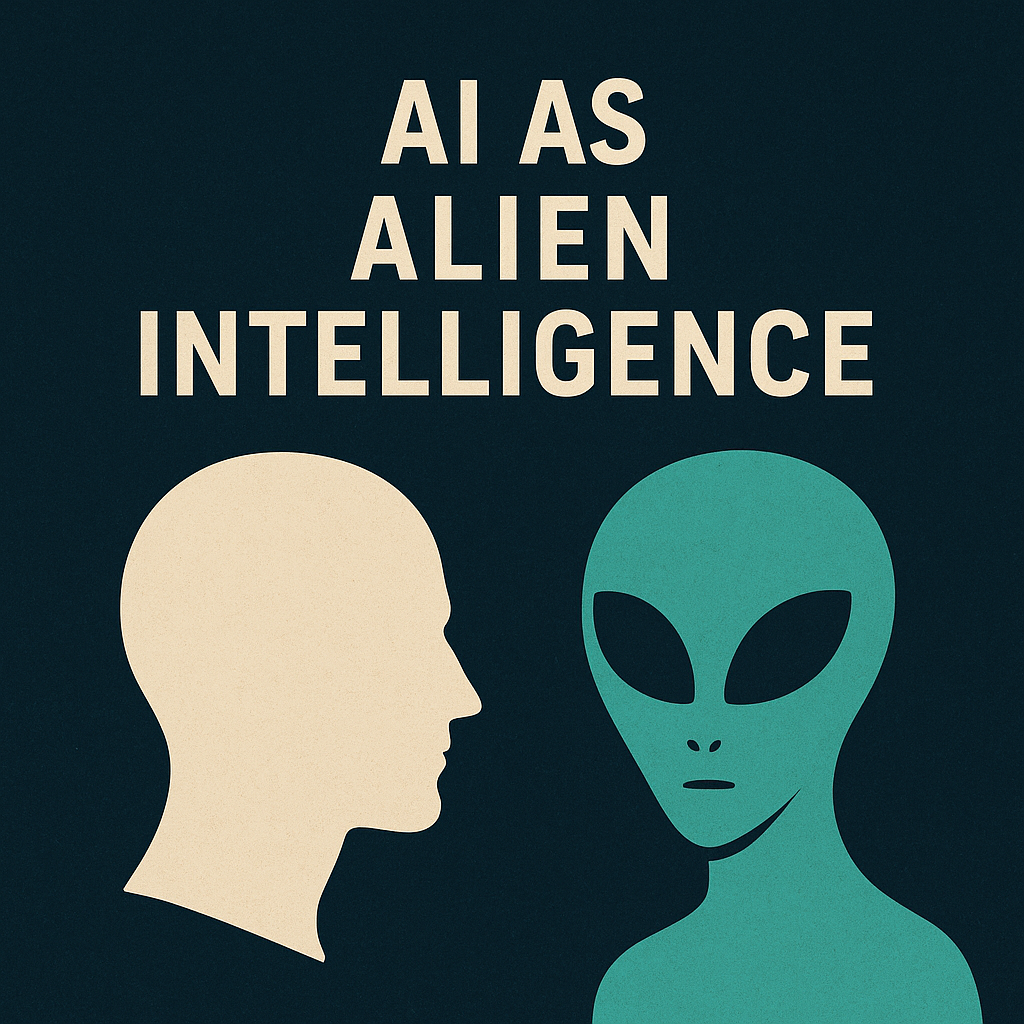
AI as Alien Intelligence: Kevin Kelly’s Radical Reframing
The co-founder of Wired argues we must stop viewing artificial intelligence as human-like and treat it as something fundamentally other
Kevin Kelly has earned a reputation for remarkably accurate technology forecasts over his five-decade career.
In the early 1990s, when the internet was a curiosity for academics and hobbyists, Kelly predicted it would transform how we live, work and communicate. While critics dismissed him then, his forecasts now appear pedestrian in their accuracy.
Today, at 73, Kelly remains one of the most influential technology thinkers of the past four decades. In 1993, he co-founded Wired — arguably the definitive publication on digital culture — and served as its executive editor for seven years. He currently holds the playful but fitting title of “senior maverick” at the magazine.
Kelly’s influence extends well beyond publishing. He is the author of landmark books including Out of Control (1994), which explored complex systems and self-organization, What Technology Wants (2010) and The Inevitable (2016), a New York Times bestseller identifying the forces reshaping our world.
His background resembles a technological monk’s journey. Kelly spent years travelling through Asia with minimal possessions, riding a bicycle 8,000 kilometres across the United States. He co-founded the All-Species Foundation to catalogue all life on Earth and serves as co-chair of the Long Now Foundation, which fosters long-term thinking for the next 10,000 years.
What distinguishes Kelly is his track record of prescient observations combined with a fundamentally optimistic outlook. While many futurists veer toward breathless hype or apocalyptic warnings, Kelly maintains a balanced perspective anchored in historical understanding.
He continues to experiment, using AI image generators and large language models daily to understand how these tools alter creativity. From this foundation, Kelly offers his most provocative thesis: we are looking at AI the wrong way.
The core argument: Different, not better or worse
For decades, humanity has asked the wrong questions about artificial intelligence.
We ask: “How close is it to human thinking?” or “When will it surpass us?” Kelly argues these questions miss the point. We should not view these systems as artificial intelligence, but as artificial aliens.
This is a fundamental reconceptualization. Kelly’s insight challenges our anthropocentric view of intelligence. As he wrote in a 2014 essay for Edge.org, “Because of a quirk in our evolutionary history, we are cruising as the only sentient species on our planet, leaving us with the incorrect idea that human intelligence is singular. It is not.”
Human intelligence occupies a tiny corner of the vast space of possible intelligences. We label our thinking “general purpose” only because we have not encountered other types of minds. As we build synthetic minds, we are realizing human thinking is not general at all — it is merely one species of thinking.
In a 2023 interview on the EconTalk podcast, Kelly clarified this distinction: “I’ve been using the AI image generators for a year now… and in every case, they’re alien — the way that they do things because they’re running on a different substrate than what we run on. Their creativity is legitimate… but it’s off, it’s different than us. It’s different, it’s alien.”
Why “alien” matters
Different cognitive architecture
AIs do not think like humans because they are running on fundamentally different hardware: silicon and code rather than neurons and electrochemical signals. As Kelly notes in The Inevitable, even if AIs approach consciousness, “they will be alien, almost as if they are artificial alien beings.”
This difference is a feature, not a bug. In his October 2025 Substack essay, “Artificial Intelligences, So Far,” Kelly emphasizes that distinct cognitive processes are the technology’s chief benefit. “There are wicked problems in science and business that may require us to first invent a type of AI that, together with humans, can solve problems humans alone cannot solve,” he writes.
Multidimensional intelligence
Kelly rejects the idea of intelligence as a single ladder. Instead, he describes it as a “radiation.” The space of possible intelligences is vast. A whale’s intelligence is superior to human intelligence in certain dimensions, yet we do not consider it “smarter” in a general sense. The same applies to AIs: they will be differently intelligent.
Multiple species of AI
Just as nature produces countless species with specialized capabilities, we will not have one monolithic AI. Kelly predicts hundreds of species of artificial minds. Some will excel at driving, others at diagnosing disease or predicting weather. Each will be an alien intelligence adapted to its domain.
The practical implications
Stop measuring against human standards
We must stop evaluating AI by asking if it can pass as human. Instead, we should ask: “What can this alien intelligence do that we cannot?” As Kelly told the Dropbox Blog, interacting with future AI will be “like interacting with Spock or Yoda. We’ll be frustrated at times because we expect them to do things they won’t be able to do.”
Embrace productive friction
The alien nature of AI guarantees surprises and misunderstandings. When image generators create art that is “weird” by human standards, it represents a different way of seeing. This friction makes collaboration generative rather than merely substitutive.
Prepare for trust challenges
We already struggle to accept answers from non-human logic. Kelly points to mathematical proofs generated by computers that are so complex only machines can verify them. As AIs tackle harder problems, humans will need to develop new criteria for trusting minds that operate differently.
The scientific revolution ahead
Kelly argues we will need alien intelligences to solve humanity’s hardest problems.
“To really solve the grand mysteries of quantum gravity, dark energy and dark matter we’ll probably need other intelligences besides humans,” he writes. He envisions a future where breakthroughs require a collaboration of hundreds of different species of minds.
Even consciousness, if developed in machines, will be alien. Kelly suggests their humour, emotions and self-awareness will be “adjacent, askew, different.” They may laugh at things we do not, or experience emotions we cannot name.
The identity crisis
Kelly acknowledges the existential challenge this poses. Surrendering uniquely human capabilities — driving, composing music, writing code, making discoveries — will be “painful and sad.”
“We’ll spend the next few decades, or even the next century, in a permanent identity crisis, continually asking ourselves what humans are good for,” he writes in The Inevitable.
Yet, he sees a paradox: “The greatest benefit is that AIs will help define humanity. We need AIs to tell us who we are.”
In a world of artificial aliens, Kelly argues that humanity’s role is to invent new kinds of intelligences that biology could not evolve. We are the bridge between biological intelligence and the vast landscape of synthetic cognition.
Looking ahead
Kelly remains relentlessly optimistic. He estimates a near 100 per cent certainty that we will manufacture an alien intelligence in the next 200 years. When we do, we will face the same re-evaluation of our roles and beliefs we would expect from contacting extraterrestrials.
The future is not about AI replacing humans, but about expanding the bandwidth of intelligence in the universe.
“The most popular AI product 20 years from now that everyone uses has not been invented yet,” Kelly said in a 2016 TED Talk. “That means you’re not late.”
We are still in the earliest days of creating artificial aliens. The galaxy of possible minds remains largely unexplored, offering an opportunity to welcome these intelligences not as threats, but as genuinely new forms of mind.
Sources and further reading
Books
- The Inevitable: Understanding the 12 Technological Forces That Will Shape Our Future (2016)
- Out of Control: The New Biology of Machines, Social Systems and the Economic World (1994)
- What Technology Wants (2010)
- Excellent Advice for Living: Wisdom I Wish I’d Known Earlier (2023)
Essays and Articles
- “Call Them Artificial Aliens” (Edge.org, 2014)
- “Artificial Intelligences, So Far” (Substack, October 2025)
- “Why We Need to Create AIs That Think in Ways That We Can’t Even Imagine” (TED Ideas)
Interviews and Talks
- EconTalk with Russ Roberts: “Kevin Kelly on Advice, AI, and Technology” (March 2023)
- TED Summit 2016: “How AI Can Bring On a Second Industrial Revolution”
- Dropbox Blog: “How Kevin Kelly Is Using AI in His Creative Process” (May 2023)
- Thinking On Paper Podcast: “Has Kevin Kelly Changed His Mind About Artificial Intelligence?” (September 2025)
Online
- The Technium (kk.org/thetechnium)
- kevinkelly.substack.com
Disclaimer and Ethics Statement
This article was researched, written and edited with the assistance of artificial intelligence tools. All factual claims have been independently verified against primary sources including Kevin Kelly’s published works, official biography, interviews and essays. The author maintains full editorial control and responsibility for the content, accuracy and conclusions presented.
In accordance with Canadian Press standards for AI-assisted journalism, we disclose that AI language models were used for research assistance, fact-checking and editing. However, no AI-generated content appears in this article without human verification and editorial oversight. All quotes have been verified against original sources.
The views and interpretations presented are those of Kevin Kelly as documented in his published work and public statements. This article focuses on Kelly’s perspective on AI as “alien intelligence” and does not constitute an endorsement of any particular approach to AI development or policy.
Readers should note that while this article presents Kelly’s optimistic framework for understanding AI, there are legitimate concerns about artificial intelligence including potential job displacement, algorithmic bias, privacy implications, environmental costs and regulatory challenges. These topics merit separate analysis and are subjects of ongoing public debate globally.
For questions or corrections, please contact the author.
Keywords: #ArtificialIntelligence #AI #KevinKelly #AlienIntelligence #FutureOfAI #TechPhilosophy #MachineIntelligence #DigitalCulture #AIEthics #SyntheticMinds #TechForecasting #Innovation #FutureTech #AITools #AIThinking #TechTrends #HumanAndMachine #NextGenAI #AIRevolution #TechInsights #DigitalTransformation #AIFuture #AICreativity #AIResearch #IntelligentSystems #AIMinds #AIExplained #TechLeadership #AI2025 #EmergingTech #AIConversation #TechThoughtLeadership #AIStory #Mindshift #AIPerspective