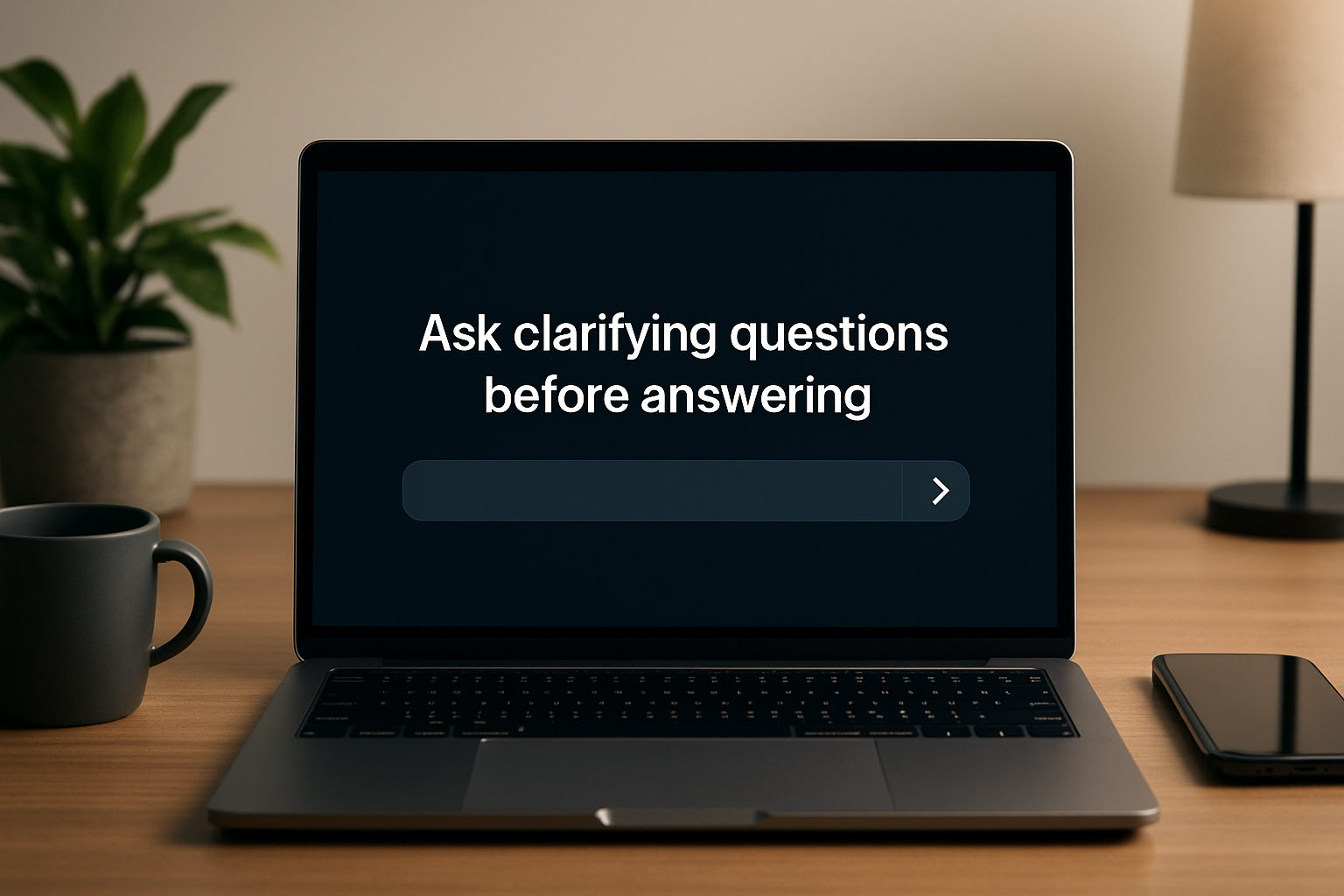
Improving AI Outcomes Through Better Prompting
AI is becoming integral to how many of us work, but too often the results still feel generic or misaligned. A small shift in how we prompt these systems can dramatically improve the quality, clarity and usefulness of their responses.
By asking the AI to seek clarification before answering, we eliminate assumptions and get far stronger outputs.
Most people continue to use AI tools as if they were search engines: ask a question once and expect a complete answer. The challenge is that large language models are trained to fill gaps when faced with ambiguity. Research from the University of Washington and Stanford shows that when prompts lack detail, LLMs tend to infer the most likely meaning instead of checking for accuracy.
A simple adjustment solves this. Adding one line to a prompt—“Ask me clarifying questions until you are at least 95 per cent confident you understand what I need”—encourages the AI to slow down, confirm the context and deliver more precise results. It transforms a one-way query into a more thoughtful exchange.
This technique has been validated across several domains. In customer support, a study involving more than five thousand agents found that clarification-capable AI increased resolved tickets per hour by up to 14 per cent. Broader enterprise research from McKinsey continues to show potential productivity gains of 30 to 45 per cent when generative AI is properly deployed within real workflows.
In financial and legal settings, Bloomberg’s financial LLM improved accuracy in several reporting tasks by nearly 50 per cent when clarification routines were added. In software development, Adyen has documented stronger consistency and reduced rework by using AI that asks targeted questions before generating tests. Even in education, research shows that Socratic-style clarification leads to better critical thinking and stronger learning outcomes.
The principle is simple: better questions drive better answers. When the AI verifies its understanding, it reduces misinterpretation, sharpens relevance and produces work that aligns more closely with what you actually need.
Here’s an easy example to try:
“Write a summary of this document. Before you begin, ask me any clarifying questions until you are 95 per cent confident you can complete this accurately.”
Instead of guessing, the AI will ask about the intended audience, tone, length, purpose and constraints. Your responses give it the context required to produce something clear, accurate and fit for purpose.
As we continue incorporating AI into our daily workflows, techniques like this ensure that the technology works with us, not around us. Encouraging the AI to ask questions first leads to outputs that are more thoughtful, more targeted and ultimately more useful.
If you test this approach, I’d be interested in what you learn—successes, missteps and everything in between. The evolution of AI-assisted work is a shared journey, and the way we prompt these systems matters more than we think.
#ai #promptengineering #clarificationprompting #askbeforeanswer #generativeai #llm #aitools #aiproductivity #enterpriseai #futureofwork #digitaltransformation #aistrategy #consultativeai #aiworkflows #betterprompts #aiinnovation #leadership #technologyleadership #ciso #cybersecurity #datastrategy #intelligentautomation #knowledgework #aiinsights #aiadoption #smarterai #askbetterquestions #aiinbusiness #businessinnovation #thoughtleadership #aipractices #collaborativeai #thinkingassistants #worksmarter