The “Double-Blind” Signal: A Security Analysis of Phreeli Wireless
In the final weeks of 2025, a new entrant in the American telecommunications market, Phreeli, made an audacious design claim: it aims to know as little about its customers as possible. Launched on Dec. 4, 2025, by Nicholas Merrill — the internet service provider owner who spent a decade fighting a PATRIOT Act-era gag order — Phreeli is a mobile virtual network operator (MVNO) designed to decouple legal identity from cellular activity.
As a security professional, I approach “privacy-first” claims with inherent scepticism. After a technical deep dive into Phreeli’s architecture and launch documentation, here is an objective analysis of where this service succeeds — and where the physics of cellular technology still create unavoidable risks.
The architecture: Double-Blind Armadillo
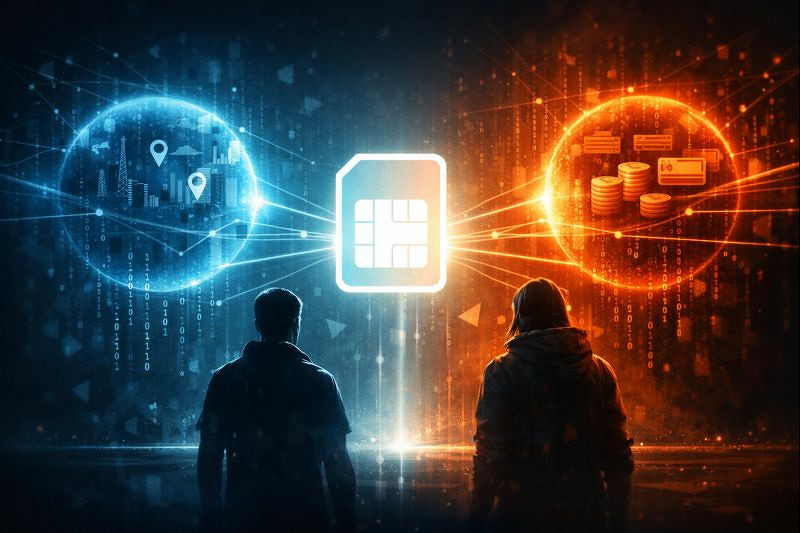
The core differentiator of Phreeli is its proprietary Double-Blind Armadillo (DBA) framework. In a standard carrier model, your name and billing information often function as primary identifiers in systems that also handle call records and location-derived metadata. Phreeli attempts to sever this link using cryptographic tokens designed to be unlinkable between billing and network systems.
How it functions
- Identity decoupling: Users sign up using only a ZIP+4 code (for tax compliance) and a username.
- The cryptographic wall: When payment is made via credit card or supported cryptocurrency, the billing system validates funds and issues a cryptographic token.
- Blind authentication: The token is passed to the network side. The network can validate that an account is “paid,” but the token is intended to be unlinkable to the underlying transaction or a real-world identity.
Technical specifications and features
Phreeli operates on T-Mobile’s 5G infrastructure in the United States. Its plan structure is tiered based on high-speed data allotments:
- Flex: US$25 a month base. Includes 2 GB at signup. High-speed data is US$20 per 5 GB.
- Essential: US$35 a month. Includes 5 GB of high-speed data.
- Core: US$50 a month. Includes 10 GB of high-speed data.
- Max: US$85 a month. Includes 40 GB of high-speed data.
All plans include unlimited talk and text, international roaming in select destinations, and international calling to more than 90 destinations — capabilities often missing from anonymous “burner” services.
The technical deep dive: trust and tokens
Phreeli’s white paper describes a design that partitions identity, payment, and network usage into three distinct “islands.” To reduce timing-correlation attacks — where an adversary matches a payment time to an activation time — Phreeli uses a Mixing Service. This service batches authorisation tokens so they are not processed in real time, blurring the chronological link between a US$50 credit card charge and a SIM coming online.
However, the white paper also notes that, for initial launch, Phreeli implemented a simplified version of the protocol. This creates a trust dependency: users must trust that the mixing service is not logging sensitive correlations internally. Until a fully provable protocol is deployed, the privacy posture rests materially on internal governance and controls, not cryptography alone.
Playing devil’s advocate: what users miss
While Phreeli is a meaningful step forward for carrier-level privacy, there are several security debts that no MVNO can fully resolve.
-
The IMEI/IMSI problem: Phreeli does not own the towers; it uses an underlying network. That network will still see device and subscriber identifiers such as IMEI (International Mobile Equipment Identity) and IMSI (International Mobile Subscriber Identity). If you insert a Phreeli SIM into a device already strongly linked to your identity through a long-standing Apple ID or Google account, the privacy gains can be materially reduced.
-
Identity gravity wells: Number portability is a common pitfall. If you port a number already tied to your bank, employer, and long-running online accounts, you reintroduce linkability. Phreeli’s Privacy Policy also indicates that additional identifiers may be provided by third parties during port-in processes.
-
ZIP+4 precision: ZIP+4 is a tax necessity, but it can still be a high-resolution geographic anchor. In dense urban areas, it may narrow location to a single building or short street segment. It is not a name, but it is often more specific than users assume.
-
Third-party payment processors: Phreeli uses Stripe for credit-card payments and NOWPayments for cryptocurrency payments. Even if Phreeli does not store card details, payment processors typically run fraud and risk controls that can involve device signals, IP addresses, and identity verification. If stronger payment privacy is required, users should prefer privacy-preserving payment methods (for example, Monero, or Zcash using shielded addresses), while recognising that exchanges, on-ramps, and merchant processors can still introduce traceability.
Threat model assessment
Before switching, a user must define their adversary. Phreeli is designed to be effective against commercial data brokers and routine civil demands by limiting the identity data it collects and stores.
However, as a US-based telecom provider, Phreeli is subject to lawful access and interception requirements, including the Communications Assistance for Law Enforcement Act (CALEA). Depending on the legal instrument and scope, providers may be compelled to support interception and/or disclose call-identifying information and related records. Even if Phreeli minimises what it retains, the underlying network must still handle telecom identifiers and routing metadata.
Use privacy tools responsibly and in compliance with applicable laws and employer policies.
Professional verdict
Phreeli is a robust attempt to reduce the collection and resale of carrier-held customer data by limiting what it stores and how systems are linked. It also aims to curtail the downstream aggregation of location- and usage-adjacent data, which remains a significant commercial ecosystem.
For high-threat users, Phreeli should be viewed as one layer in a defence-in-depth strategy. To achieve its full potential, it should be paired with a privacy-hardened device posture (for example, GrapheneOS), privacy-aware payment choices, and careful operational separation from long-standing accounts and identifiers.
As of Dec. 17, 2025, I have not seen a publicly released independent security assessment of the production environment. Readers should treat the strongest privacy guarantees as design claims until validated. It is a promising start, but in security, we verify — then trust.
Sources reviewed
- Phreeli official website: phreeli.com (Privacy Policy, FAQ, and plan tiers)
- Phreeli technical white paper: “Double-Blind Armadillo: An Architecture for Anonymous Wireless”
- WIRED: “A New Anonymous Phone Carrier Lets You Sign Up With Nothing but a Zip Code” (Dec. 4, 2025)
- Android Authority: “New privacy-focused MVNO Phreeli doesn’t even record your name” (Dec. 4, 2025)
- FCC: Communications Assistance for Law Enforcement Act (CALEA) guidance materials
- TechRadar: “This new anonymous phone carrier doesn’t even need your name — here are 5 things you should know about it” (Dec. 5, 2025)
Disclosure and methodology: This post is not sponsored. I have no commercial relationship with Phreeli, its founders, employees, investors, or affiliates, and I have not received compensation, products, discounts, or other consideration in connection with this review. I wrote this analysis using publicly available information only, including Phreeli’s published website materials and third-party media coverage cited below. I did not perform hands-on testing (for example, packet capture, device/SIM provisioning experiments, or a code review of backend systems). This is an independent security and privacy analysis, not legal advice.
Keywords: #Privacy #PrivacyTech #Security #Cybersecurity #InfoSec #Telecom #Wireless #MVNO #MobileSecurity #DataPrivacy #PrivacyFirst #DigitalPrivacy #Surveillance #Metadata #ThreatModel #OSINT #ZeroTrust #RiskManagement #SecurityResearch #SecurityAnalysis #PrivacyEngineering #Cryptography #ZKProofs #Anonymity #OpSec #InfosecCommunity #MobilePrivacy #DataBrokers #CALEA #LawfulIntercept #TMobile #eSIM #GrapheneOS #Monero