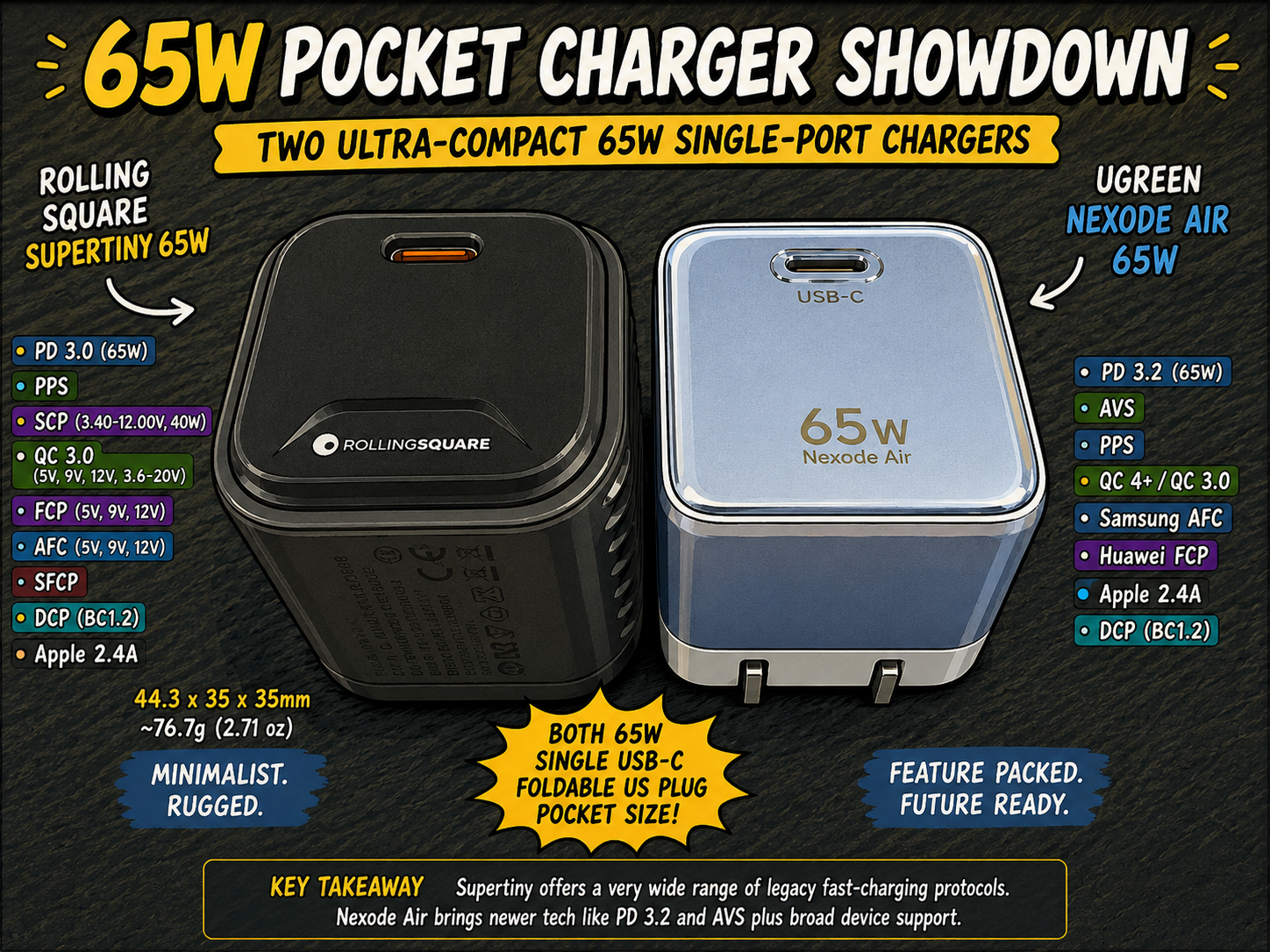
UGREEN Nexode Air 65W vs. Rolling Square Supertiny 65W – Initial Protocol Comparison
I recently picked up two ultra-compact, single-port 65W GaN chargers:
- UGREEN Nexode Air 65W
- Rolling Square Supertiny 65W
Using a ChargerLAB POWER-Z KM003C (firmware 2.0.3), I compared the charging protocols each charger advertises.
UGREEN Nexode Air 65W
The Nexode Air advertises:
- USB PD 3.2 (65W)
- AVS (Adjustable Voltage Supply)
- PPS
- Qualcomm Quick Charge 4+
- Qualcomm Quick Charge 3.0 (3.6–12V)
- Samsung AFC
- Huawei FCP
- Apple 2.4A
- BC1.2 DCP
Rolling Square Supertiny 65W
The Supertiny advertises:
- USB PD 3.0 (65W)
- PPS
- Qualcomm Quick Charge 5
- Qualcomm Quick Charge 3.0 (3.6–20V)
- Huawei FCP
- Huawei SCP (3.4–12V, up to 40W)
- Samsung AFC
- SFCP
- Apple 2.4A
- BC1.2 DCP
Observations
Both chargers support the charging standards that matter most for modern USB-C devices:
- USB Power Delivery
- PPS
- 65W maximum output
However, there are several notable differences.
The UGREEN Nexode Air advertises USB PD 3.2 and AVS (Adjustable Voltage Supply), making it the more up-to-date implementation of the USB Power Delivery specification.
The Rolling Square Supertiny advertises USB PD 3.0, but supports a broader collection of legacy charging protocols. In addition to PPS, it also advertises QC 5, Huawei SCP, SFCP, Samsung AFC, and Huawei FCP.
Another interesting difference is Quick Charge 3.0 support. The Nexode Air advertises the standard 3.6–12V QC 3.0 range, while the Supertiny advertises an extended 3.6–20V QC 3.0 range.
At a glance
-
UGREEN Nexode Air 65W
- ✅ USB PD 3.2
- ✅ AVS
- ✅ PPS
- ✅ QC 4+
- ✅ QC 3.0 (3.6–12V)
- ✅ Samsung AFC
- ✅ Huawei FCP
- ✅ Apple 2.4A
- ✅ BC1.2 DCP
-
Rolling Square Supertiny 65W
- ✅ USB PD 3.0
- ✅ PPS
- ✅ QC 5
- ✅ QC 3.0 (3.6–20V)
- ✅ Huawei SCP (up to 40W)
- ✅ Huawei FCP
- ✅ Samsung AFC
- ✅ SFCP
- ✅ Apple 2.4A
- ✅ BC1.2 DCP
Conclusion
From a protocol perspective, the UGREEN Nexode Air focuses on the latest USB Power Delivery ecosystem with PD 3.2 and AVS, while the Rolling Square Supertiny emphasizes compatibility by supporting a wider range of proprietary and legacy fast-charging protocols.
It’s worth noting that these observations are based on what each charger advertises during protocol negotiation using the POWER-Z KM003C. They do not necessarily reflect real-world charging performance, efficiency, thermal characteristics, or long-term reliability.
Ethics and Transparency Statement
This article reflects my independent testing and analysis. I have no affiliation with UGREEN, Rolling Square, ChargerLAB, Amazon, or any other company mentioned. I did not receive compensation, discounts, free products, or editorial input from any manufacturer or retailer.
Both chargers were purchased by me through normal retail channels.
This article is based on my own testing, publicly available product information, manufacturer documentation, and observations using a ChargerLAB POWER-Z KM003C. Generative AI tools were used to assist with editing and presentation, but the testing, conclusions, and opinions are my own.
Disclaimer
This article is provided for general informational and educational purposes only. It should not be considered engineering, electrical, safety, or professional advice.
Charging protocols advertised by a charger do not necessarily reflect its real-world performance, efficiency, thermal characteristics, or long-term reliability. My observations are limited to the devices tested and the conditions under which the testing was performed. Results may vary with different firmware versions, cables, connected devices, environmental conditions, and production revisions.
The opinions expressed are my own and do not represent those of my employer, clients, partners, or any affiliated organization.
Keywords: #UGREEN #NexodeAir #RollingSquare #Supertiny #USBPD #USBPD32 #USBPD30 #PPS #AVS #USBC #GaN #GaNCharger #QuickCharge #QC5 #QC4Plus #HuaweiSCP #HuaweiFCP #SamsungAFC #PowerDelivery #ChargerLAB #POWERZ #KM003C #FastCharging #LaptopCharger #USBCTest #TechReview #HardwareReview #Kiledjian