
Samsung Galaxy now comes in 5.8 & 6.3 inch Mega size
Pictures of some entry level iPhone parts
With the increased competition from low cost Android devices, most Wall Street analysts & tech pundits agree that Apple will have to eventually release a more affordable iPhone. Something Apple can sell in developing markets to fight off Google.
Until now, this has been all speculation but Japanese Apple blog Macotakara has published pictures of a vibration motor not used in any iPhone. iLab Factory (the source of the photos) believes it is part of the upcoming cheaper iphone.

Samsung Galaxy SIV International faster than US version
We have seen a steady stream of Samsung Galaxy SIV performance benchmarks since it was released. All of the performance benchmarks have been performed with the US version.
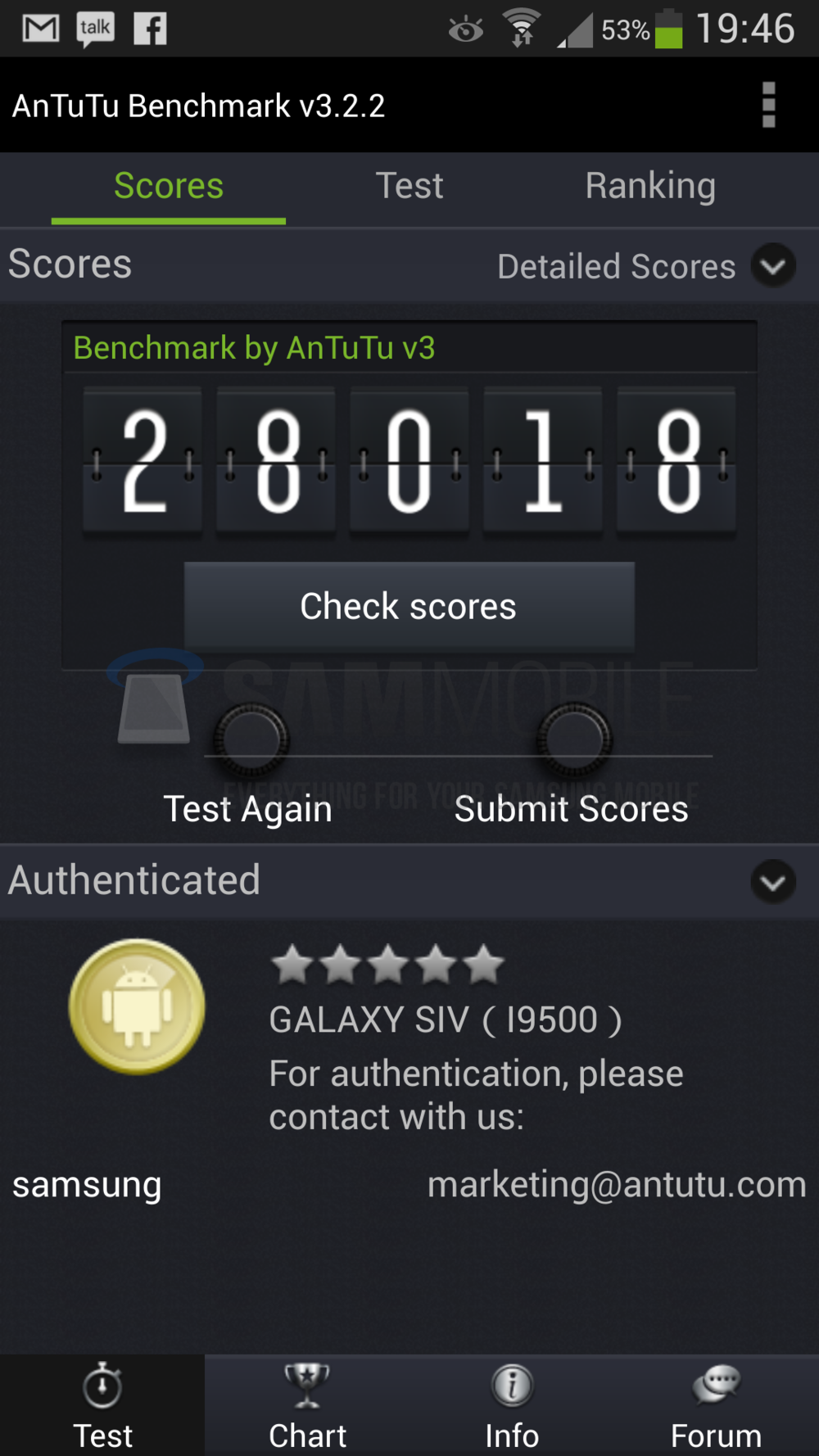
The US/Canadian version of the Samsung Galaxy SIV will come equipped with a Qualcomm Snapdragon 600 processor. The global version will come with the gargantuan Samsung Exynos 5 Octa (8 core) processor. We have been wondering how this Samsung processor would compare to the Qualcomm and now we know. SamMobile has performed the benchmark we have all been waiting for and it seems the Exynos 5 is significantly faster.
The US version scored a respectable 23,607 in AnTutu whereas the Exynos 5 based international version scored a scorching 28,108 (using the 1.9GHz Exynos 5). The Asian variant is expected to be even faster.
Some may be wondering why the US/Canadian version comes with the Snapdragon and not the Exynos 5 octa.
No one has a definite answer but many speculate Samsung can't manufacture enough Exynos 5s to meet the US demand (the Snapdragon was their fallback plan).
What is Metal As A Service (MaaS)
Just when you thought companies could create another blah blah as a service acronym, Canonical has thrown a couple of new letters at us: MaaS. MaaS stand for Metal As A Service and is a metal to server management service created by Canonical (the team behind Ubuntu).
In the old days (aka last couple of years) companies went crazy buying the biggest meanest servers they could buy to do all they number crunching and big data analysis. The bigger the company the bigger and more expensive the servers they bought. The cloud paradigm forced a shift in approach, since it meant your work got chunked and processed by dozens or hundreds of servers (not one monster monolithic beast in a special room). Cloud meant you no longer cared about processor speed, bus speed, computational capacity of one node, etc. In the cloud, your work can be handled by thousands of smaller, cheaper commodity servers.
Canonical believes MaaS is the secret sauce that allows you to think of your servers as commodity devices that offer services and not as big expensive electronics (what it can do not what it is).
In the world of Ubuntu, MaaS will manage your hardware and Juju will manage your apps and workload. As you read this, you would be forgiven if thoughts of self-deploying OpenStack servers come to mind. This is the market Canonical is targeting.
Metal As A Service is new in Ubuntu 12.04 and you can expect a quick bump is features over the next 12-18 months. Canonical wants to add BIOS and RAID firmware updating capabilities, authentication integration and various self-managed pre-built testing schemes.
Not surprisingly, tech reporters are divided about the usefulness of this new technology (and other competitors in this space). Some believes it is a solution to an age old problem while others believe it is a solution looking for a problem.
I think MaaS is an much needed product in its infancy and it will be important to see how it competes against the likes of Nebula One (which to me seems like a much more refined and enterprise ready solution).
Desktop As A Service is cheaper and easier to implement
Having worked in the IT field for close to 20 years now, I am constantly surprised that the biggest pain points for most organizations are still the most basic IT components. One such pain point for companies large and small is desktop management. What should be a commodity easy to manage system is still proving to be a big challenge for most organization.
I believe over the next 3-5 years, we will see a huge uptake in Desktop As A Service (DAAS). DAAS is and will continue to be a cost effective solution to tame the unruly desktop management monster in a secure way.
We are seeing demand for DaaS growth quickly and the trend is expected to continue for the foreseeable future. What is fueling the demand for Desktop as a Service? Companies are being challenged to deliver a secure computing environment is the face of Bring Your Own Device (BYOD), a large mobile remote workforce, migration issues to Windows 7/8 and complex regulatory requirements.
Virtual Desktop Interface (VDI) was touted as the tech messiah that would deliver IT organizations from all of the above issues but VDI simply hasn’t caught on. It is complex to implement, costly and difficult to manage. In my unofficial poll, 65-80% of VDI projects fail to get implemented or fail to deliver the promised value.
DaaS seems to address all of the above issues by providing a cost effective, quick to deploy and easy to manage desktop for your users (regardless of their device, location or connection speed).
Google may buy WhatsApp

Digital Trends is reporting that Google is in talks with WhatsApp about a potential acquisition. It seems WhatsApp is pushing for a $1 billion valuation.
WhatsApp is a private company and doesn’t share subscriber information but the industry believes they should have about 300 million active users. December 31 2012, they processed 18 billion messages. WhatsApp is one of the most popular platform agnostic messaging systems with deep penetration in Europe and Latin America.
Why would WhatsApp consider selling? No one knows for sure but I believe it may be because of strong competition from Asian providers such as WeChat (China) and Kakao Talk (Korea). Competing with these fast growing competitors may be costly and WhatsApp may be looking for a new owner with deep pockets.
If Google can acquire WhatsApp, it would be a major blow to Facebook who is trying to catch up to the Instant Messaging train.
Possible repercussions
WhatsApp has always been an ad free app and it would be interesting how consumers would react to a Google owned WhatsApp with advertisements. Many users chose WhatsApp because it was an independent player and IM was one piece users didn’t want to provide to Facebook or Google for data mining.
It is safe to assume some users will be disgruntled and leave.
Free app to clean junk files from your Android device
I am an iPhone user playing with Android and was surprised when I learned I have to “maintain” my Android devices. One of the main maintenance tasks I do on Windows machines that I also have to do on my Android tablet is “getting rid of junk files”.
These files consume precious storage space you definitely want to reclaim. After testing over 20 different apps, I have finally settles on a free software called Clean Master. This app cleans application cache files, orphaned files after uninstalling apps and deletes app histories.
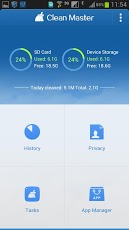
Cleanup is simple and quick with one click. It also provides storage utilization metrics so you can determine which apps are using the most of your precious space (like WinDirStat on Windows).
Download this free app here.
Gunnar Optiks computer glasses Review
Knowledge workers and serious gamers will tell you starring at a bright screen for hours at a time takes its toll (eye strain, headaches, etc.) If you work in an office environment will little natural light and lots of white artificial light then the situation becomes even worse.
About 2 months ago, I noticed that my eyes were dry, I was getting more frequent head aches and generally felt worse from wear after spending most of the day starring at a screen. I needed a solution and after a couple of days I stumbled on a company called Gunnar Optiks. Gunnar Optiks sells glasses specially designed to make using a screen gentler on the eyes.
They have a bunch of models depending on your needs but at the end of the day, they all share the same purpose in life. So I picked up a pair at my local Best Buy (GUNNAR Optiks MLG Legend Gaming Eyewear) and have been using them for 2 months (5 days a week, 10 hours a day).
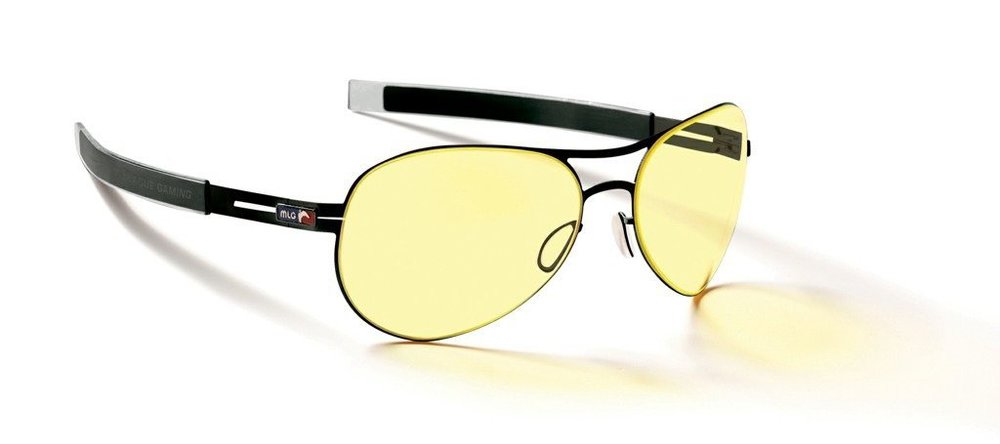
Do Gunnar Optiks glasses work?
Did they improve my overall computer use experience? Yes!
The build quality of the glasses are decent. It is solid enough to last a good while but nothing to write home about. The MLG Legend was very light so even though I didn’t normally wear glasses, it was easy to keep them on and not be bothered. I find the designs modern and attractive which is important. You can wear these and not stick out.
The main attraction are the technologies the company claims make the lenses unique : amber iONik lens tints, fRACTYL lens geometry, diAMIX lens material, and i-Fi lens coatings. Each technology is supposed to make your experience more enjoyable by reducing harsh glare, improving the geometry when looking at a close screen, keeping eyes more humid, etc. As a consumer, you really can’t test any of these claims so I won’t spend too much time talking about them. The real question is does it help? Was it a good purchase (using my own money)? The answer is Yes and Yes.
The slightly yellowish tint improved contrast and reduced the harshness of computer screens and artificial office lights. Whether it’s the tint or the geometry, something in these glasses also seems to reduce glare.
Annoyances
As good as the glasses are, there are some shortcomings that I wanted to highlight.
The glasses attract and retain smudges, oil and dust. I really wish they had some kind of coating to repels these. The kit came with a microfiber carrying case that you can use to clean the lens but I found it ineffective. The only way to clean the lenses was with a lens liquid and a good lens cleaning cloth.
Although the glasses are of decent quality, I was expecting slightly better built frames for an $80 pair of glasses. Granted you are paying for all that lens technology but still….
Conclusion
Overall I enjoyed using the Gunnar Optiks glasses and found myself using them every day. This certainly isn’t a necessity; after all I have been using computers for many years without these just fine but it definitely improves your wellbeing.
The main question is “Are they worth $80?” and this is a difficult question to answer. If you have gotten to the point where you constantly have tired eyes, dry eyes or headaches after using a monitor for a couple of hours, then you should run out and buy a pair. If you aren’t afflicted with one of the above symptoms, my recommendation is more muted. As much as I liked them and found myself using them every day, I isn’t easy to justify spending $80 if you don’t have an immediate direct need.
Outlook coming to Surface RT
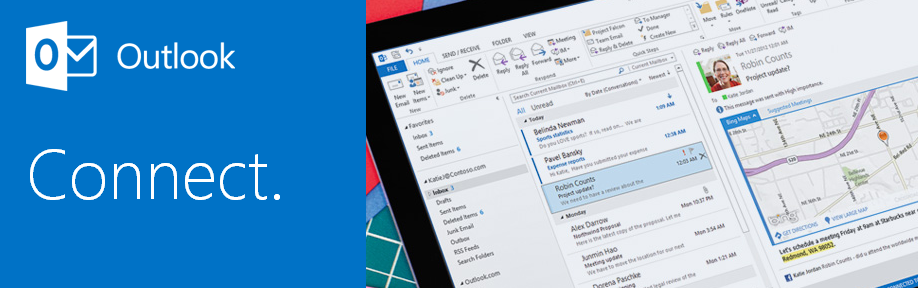
Like it or hate it, the Microsoft Surface RT tablet is an original creation forcing us to think differently about the tablet market. As good as some think it is, most users agree it is missing one main tool, Microsoft Outlook. It seems Microsoft may have heard your complaints and may be preparing to release Outlook for Surface RT (according to the Supersite for Windows). The article says a bug in the ARM chipset (the tablets brain) may have caused the delay in the release.
Obviously Microsoft is committed to the new tiles interface of Windows 8 / RT and is going to continue refining the user experience. Sales of the Surface RT have been soft but Outlook may be the driver that finally pushes it into the arms of waiting power-users and corporations.
Apple gaining momentum against Android
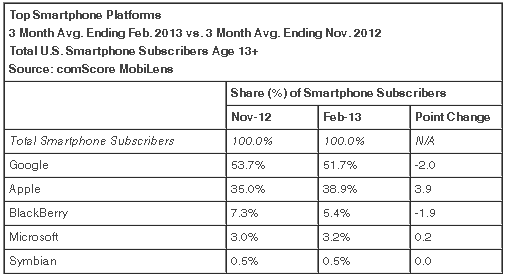
comScore has published it’s smartphone Subscriber Market Share statistics and it looks like Apple my be heading higher while Android takes a little dip. Google’s dark night (aka Android) dropped 2% in the latest period (51.7%) while Apple’s IOS gained 3.9% (38.9%).
Microsoft and Blackberry both lost ground and it’s not even worth mentioning.
I think the big test for Apple will be the summer release of IOS 7 and the next iPhone (the iPhone 5s?). If they manage to deliver a compelling product then I think they may manage to win back a big chunk of the market. However if they deliver a boring ho-hum release of IOS and the iphone then I’m afraid Apple may see a sizeable drop in market share. I have been an iPhone user from day 1 but am now on the fence, waiting for the next release before I decide to upgrade to another iPhone or finally jump ship to the Android world.
Chrome to start using Blink soon
I previously wrote that Google will be using its own rendering engine called Blink "soon".
Now we learn that this wi be part of the stable Chrome release of version 28 (gracing us in about 10 weeks).
Can't wait to test drive it and see how it performs.
What's new in Google Chrome version 27 beta?
Like most tech savvy computer users, my browser of choice [in the pre-Chrome days] was Firefox. It was the most stable and secure browser around (compared to Internet Explorer, Opera, etc).
We all love Chrome because it is a fast browser, has a clean uncluttered interface and is constantly updated. We recently received the stable version of Chrome version 26 and now adventurous users can start playing with the beta version of Chrome version 27.
After all the hoopla about Google changing Chrome’s rendering engine to its new in-house Blink product, you may have thought that version 27 may have finally implemented it. Well it doesn’t.
Chrome is still the safest, fastest and [in my opinion] best browser.
From an end user perspective, version 27 brings small user interface improvements and a very slight performance boost. Everything else is for developers. Hopefully we see Blink in version 28.
Chromium blog post talking about version 27 can be read here.
How do I download Chrome beta?
If you downloaded Chrome through the regular channels then you are on the stable release channel which means your browser will auto-update when a final stable release is made available by Google.
If you are more adventurous and want to beta test non-final versions, then go to this website and download the special installer that will give you access to the beta channel. This means your browser will update much more frequently with every beta version made available by Google. This is my channel of choice but I am technical enough to work through any beta related issues I may experience.
Version 27 is now released in the stable release. It contains 4 main changes:
- web pages load 5% faster
- Improvements to the ranking predictions, spell correction and omnibox predictions
- contains a bunch of security fixes.
Go forth and enjoy a faster more stable web
Homeless man wins $50,000 from lotto

Dennis Mahurin. (CINewsNow)
Dennis Mahurin has been homeless since 1978, living in a tent and happy about it. He recently won $50,000 from an instant win scratch off lottery but says he doesn’t want to change his lifestyle. Instead of “hording” all the money for himself, he wants to continue being homeless and share his good fortune with other homeless friends. He wants to spread most of his winnings ($35,000 after taxes) in chunks of $100 with his friends.
Original story by CINewsNow
Government can't intercept Apple's iMessage
It shouldn’t surprise anyone that Apple is very secretive about how its technologies are designed. Case in point, we all knew iMessage had some type of encryption
Now we learn that the security is so well designed that even the Drug Enforcement Agency (DEA) isn’t able to intercept iMessages [according to CNET at least]. This is great news for privacy advocates but a worry for law enforcement.
Test Blackberry Z10 from the comfort of your browser
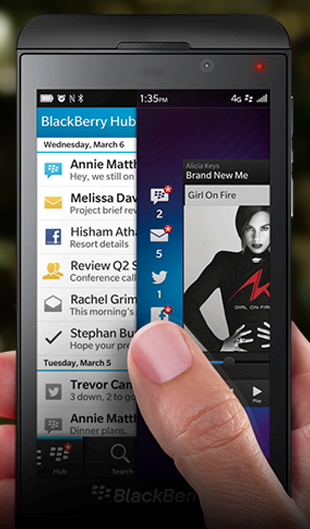
Interesting in testing out the Blackberry Z10 but don’t know where to take it for a test drive? Blackberry wants to make this easier and has created a special site you access via your IOS or Android browser which replicates some to the key Blackberry Z10 functionality. It is an interesting walk through of some of the key gestures, multitasking functionality, shows the Blackberry hub, BBM and time shift.
It isn’t a full emulator but it is enough for you to decide if it is interesting enough to drive to your local mobile phone shop.
What should your 2013 raise be?
Most employees over-estimate their value to their company and therefore expect too much of a raise. In 2012, the typical raise was between 1.9 – 2%. Highest performers seem to receive around 4%.
What does this mean? It means you should set realistic raise targets so you’re not disappointed when your boss gives you that raise letter. The best thing you can do is to continually touch base with your boss (over the year) to ensure your evaluation of your performance is in-line with your boss’ evaluation.
Do more than your boss expects
Many colleagues I have coached overestimate their worth to the company and almost always think they are underpaid. The key message is that your company pays your salary to do your job. You only deserve a raise if you are performing to a higher level than that expected from your boss.
To add value to your boss (and become raise worthy), make your boss’ life easier:
- Ensure you deliver on all of your commitments on time and to the exact expected quality
- Keep your boss updates on the items you are working on for him/her
- Volunteer to take on additional more challenging responsibilities
- Be attentive to issues experienced by your boss and come up with creative ways to solve them (even if it isn’t your job)
Make yourself indispensable and a raise will usually follow.
Samsung Galaxy SIV faster than the iPhone 5
Analysts were spreading incredible rumors prior to the launch of the Samsung Galaxy SIV and were disappointed when the device delivered a more bland device. Primate Labs took the US version of the Galaxy SIV for a test drive against its main competitors what it seems to have performed really well.
Looks like the US version smokes the HTC One, Google/LG Nexus 4, Samsung Galaxy S3, the iPhone 5 and the Blackberry 10.
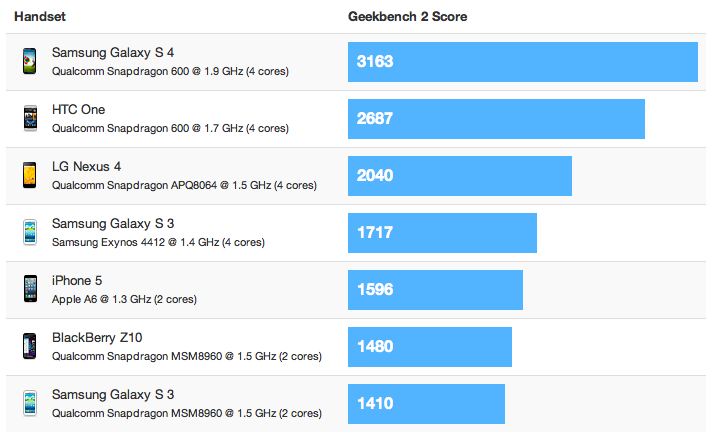
See the detailed benchmark here.
Apple begins iPhone 5s production for July/August launch
A new report sent to the Wall Street Journal says Apple will begin production of the next generation iPhone sometime in Q2 (aka starting now). The report claims the new device (iPhone 5s) will have the same shape and design of the existing iPhone 5.
The report provides the same release info other rumors have mentioned, which is a July/August lunch. The much rumored “cheap” iphone for developing countries is expected sometime in the second half of the year.
I have been an iPhone user from the very beginning but am now feeling left behind when comparing device functionality to major Android competitors. If the iPhone 5s only increases CPU and GPU speed, I worry many will jump ship to competing Android device which seem to be offering a much more compelling solution.
Samoa Air charging based on passenger weight
Samoa Air has done the unthinkable by charging passengers based on how much they weigh. When buying a ticket, customers must enter their weight and the weight of their luggage before the airline provides the customized weight based fare during the booking process.
This weight information is then verified at the airport to keep customers honest. The airline claims that a typical family with 2 adults and 2 mid-sized children will likely pay less than the old pricing model.
It is important to remember that Somoa Air is a small carrier that operates small 12-seat plane where passenger weight (including luggage) accounts for the majority of take-off weight.
Source: Sydney Morning Herald