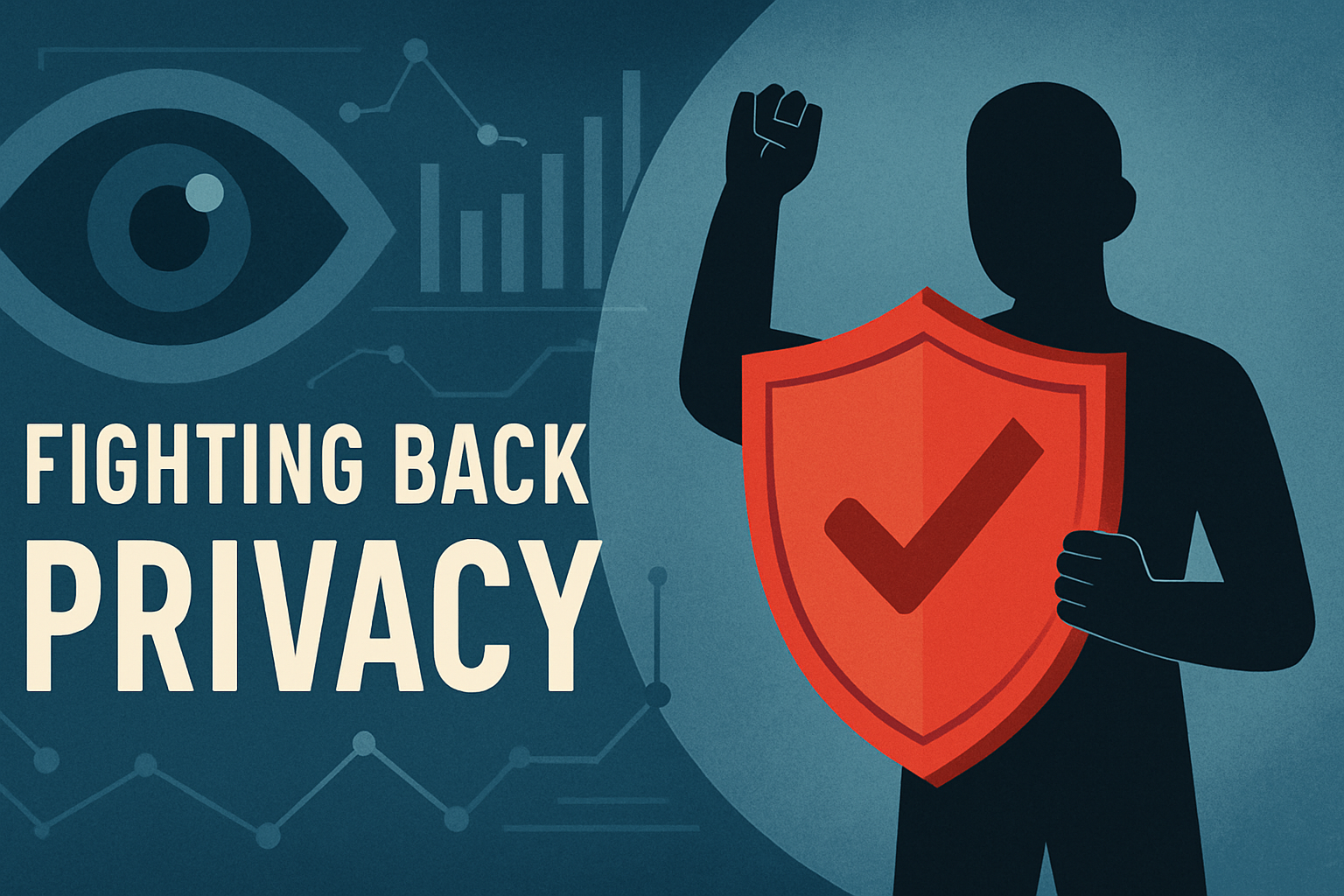
The ad blocker that fights back: why AdNauseam deserves your attention
When most people think about ad blockers, they picture a simple transaction: install the extension, ads disappear, browsing improves. But what if I told you there is an ad blocker that does more than hide from the surveillance economy — it actively sabotages it?
Meet AdNauseam, and prepare to have your assumptions about online privacy challenged.
The problem with just hiding
Traditional ad blockers act like digital invisibility cloaks. They clean up your browsing experience, but they do not address the underlying issue: advertising networks continue building behavioural profiles about you. They know the sites you visit, the ads you ignore and the patterns your browsing reveals.
Think about it this way: when you walk past store windows without stopping, retailers still learn something about you. The same idea applies online, except the tracking is more sophisticated and the consequences more serious.
This is where AdNauseam stands out.
Obfuscation as resistance
Built on top of uBlock Origin, AdNauseam takes a markedly different route. Rather than only blocking ads, it quietly “clicks” on all of them in the background. You never see the ads — they are hidden as usual — but behind the scenes, AdNauseam generates phantom clicks.
The result is simple: your advertising profile becomes useless.
Imagine trying to categorise someone who appears to be interested in everything: luxury cars and discount flights, steak houses and vegan cafés, college admissions and retirement planning. The data becomes noise. Profiling becomes unreliable.
This is not just engineering — it is a form of digital protest.
The Google problem
Here is where the story becomes even more compelling. In January 2017, Google banned AdNauseam from the Chrome Web Store. The official justification was a vague developer agreement violation.
But Google’s business depends on one thing: accurate ad targeting. AdNauseam directly undermines it.
When MIT Technology Review tested the extension in 2021, working with co-creator Helen Nissenbaum, they found Google’s systems treated many of the phantom clicks as legitimate — and billed advertisers accordingly.
A free, open-source privacy tool was generating fraudulent-looking ad traffic that cost advertisers money and corrupted the data that fuels Google’s revenue engine.
Google’s response was swift and severe. Not only did it remove AdNauseam from its store, it labelled the extension as malware, making installation even in developer mode difficult.
The ethics of clicking
Some critics claim AdNauseam is a form of click fraud. That argument does not hold up.
Click fraud generally involves malicious actors attempting to drain competitors’ budgets or inflate their own revenue. AdNauseam does neither. It introduces noise on behalf of users who explicitly choose to pollute their own advertising profiles.
If you believe individuals have a right to privacy and a right to resist invasive tracking, then the ability to introduce noise into that tracking is part of that right.
Should you use it?
AdNauseam is not for everyone.
If you want the most stable, low-maintenance ad-blocking experience, stick with uBlock Origin. It is excellent and reliable.
AdNauseam has limitations. Its ad-clicking system can be inconsistent. Some users report that it collects far fewer ads than it blocks. Some sites experience occasional issues. And, as a smaller project fighting constantly evolving ad platforms, it cannot always keep pace.
These are trade-offs. The question is whether active resistance is worth the bumps along the way.
If you dislike being treated as a data source for trillion-dollar advertising platforms, AdNauseam offers something rare: a way to fight back.
It works on Firefox, Opera, Microsoft Edge and Brave. Chrome users must install it manually from adnauseam.io. Google has ensured it requires effort.
The bigger picture
AdNauseam is part of a wider movement of privacy tools focused on obfuscation rather than passive protection. Tools like TrackMeNot and the Tor network share this philosophy.
When regulation fails to keep pace with corporate surveillance practices, individuals rely on technical means to protect themselves. Sometimes, the best defence is to create noise.
Ethics and disclosure
The views shared here are my own as a privacy advocate and observer.
I have no financial connection to the AdNauseam project.
Using AdNauseam does have economic implications. Phantom clicks cost advertisers money and affect publisher revenue. Some see this as justified resistance. Others see collateral damage. You will need to decide where you stand.
This post discusses methods of resisting surveillance. While I support the right to privacy, this is not legal advice. Legal status varies by jurisdiction.
A final thought
After decades working in global security and privacy, one lesson stands out: privacy is fundamentally about power.
AdNauseam shifts a small amount of that power back to individuals. It demonstrates that we do not have to accept surveillance as the cost of participating online.
Is it perfect? No.
Will it dismantle surveillance capitalism? No.
But it proves that obfuscation is a valid privacy strategy — and that sometimes the most meaningful act of resistance is refusing to be predictable.
Your data. Your terms. Consider fighting back.
AdNauseam is free, open-source software created by Daniel Howe, Helen Nissenbaum and Mushon Zer-Aviv. Available at adnauseam.io.
Keywords: #privacy #cybersecurity #adnauseam #dataprotection #onlinesecurity #infosec #privacytools #digitalrights #surveillancecapitalism #adblocker #uBlockOrigin #opensource #techethics #browserprivacy #websecurity #adtracking #dataprivacy #personalprivacy #internetfreedom #antitracking #surveillance #securityawareness #digitalresistance #privacyadvocate #userprivacy #techpolicy #ethicaltech #privacybydesign #cyberawareness #privacyprotection #infoseccommunity #cyberresilience #datasecurity #freesoftware #internetprivacy