The Art of the Gray Man: How to Travel Smart, Stay Safe, and Experience More of the World
“Travel is fatal to prejudice, bigotry, and narrow-mindedness.”
— Mark Twain
Travel changes how we see the world.
It exposes us to new cultures, unfamiliar environments, and perspectives that challenge our assumptions. But the moment you leave home, one fundamental reality shifts:
You are playing an away game.
Different social norms. Different systems. Different risks.
You do not need to be paranoid when you travel.
You need to be deliberate.
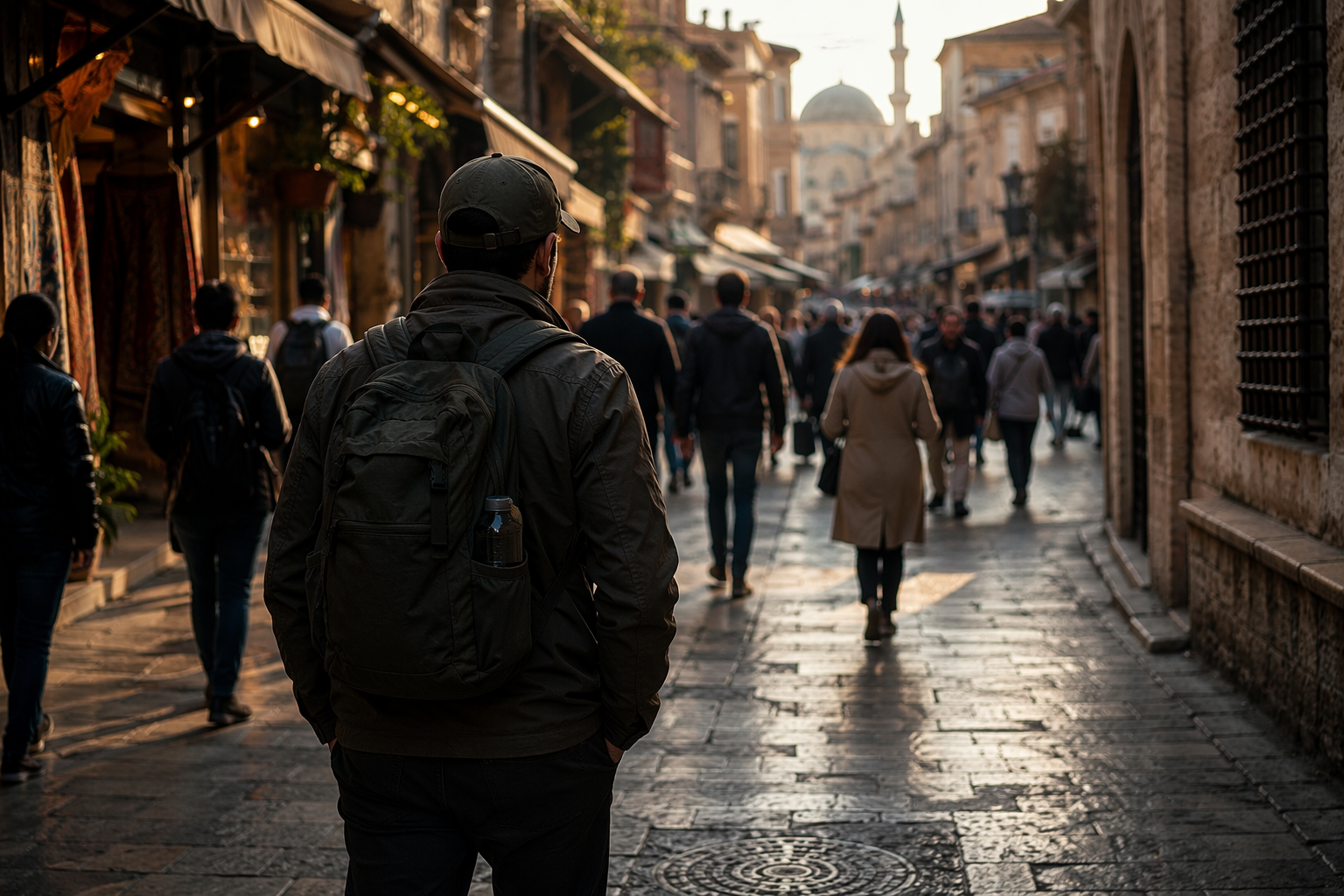
Security professionals often use a concept known as the gray man. The philosophy is simple: blend into your environment so completely that you never attract attention in the first place.
The goal is not to hide.
The goal is to be so unremarkable that no one remembers you.
Most criminals are not looking for confrontation. They are looking for opportunity — someone distracted, uncertain, or visibly out of place.
The gray man approach simply removes that opportunity.
Understand the Environment Before You Arrive
Preparation is the easiest form of risk reduction.
Every destination has its own rhythm — neighbourhoods with different reputations, transportation systems that function differently, and scams that target predictable tourist behaviour.
Many tourist scams operate by blending into normal tourism activity: taxis, street vendors, casual conversations, or unofficial “guides.” Without context, visitors often struggle to recognize the deception.
Before arriving somewhere new, take a few minutes to understand:
- Which neighbourhoods are safe and which to avoid
- How transportation and taxis normally work
- Common scams reported in that city
- Local expectations around tipping, bargaining, and pricing
Scammers depend on visitors not knowing what “normal” looks like.
Establish that baseline before you land.
Manage Your Signature
In security circles this is called signature management.
Everything about you communicates signals: clothing, luggage, posture, behaviour, and even how you interact with your surroundings.
Large designer bags, expensive watches, oversized camera equipment, and highly branded clothing immediately identify you as a visitor. Bright logos and conspicuous brands do the same.
Ironically, overly tactical gear can be just as conspicuous. Many people attempting the “gray man” approach mistakenly dress like a character from a survival film — tactical backpacks, MOLLE webbing, and combat boots. The result is the opposite of blending in.
The gray man approach sits in the middle:
- Neutral colours
- Simple clothing
- Functional but understated gear
- Nothing that signals wealth or special preparation
Dress like the people around you.
If someone later tried to describe you, the ideal response would be:
“I don’t really remember.”
Move Like You Belong
Clothing is only part of the equation. Body language often reveals far more.
People who appear distracted, hesitant, or uncertain are more likely to be perceived as easy targets. Confident movement communicates the opposite.
When navigating unfamiliar environments:
- Walk at the pace of local foot traffic
- Maintain upright posture
- Keep your head up instead of staring at your phone
- Avoid stopping abruptly in crowded areas
If you need to check directions, step into a café or store rather than standing on the street looking lost.
Confidence is not about knowing exactly where you are going.
It is about looking like you do.
Maintain Situational Awareness
Situational awareness is the most valuable skill a traveller can develop.
Unfortunately, modern habits often degrade it. Headphones eliminate environmental sound. Phones absorb attention. Alcohol reduces perception and reaction time.
Every environment has a baseline — the normal rhythm of movement and behaviour.
When something deviates from that baseline, it deserves attention.
Examples include:
- Someone lingering where people normally pass through
- A person repeatedly appearing in multiple locations
- Behaviour focused specifically on you rather than the environment
Most opportunistic crime relies on one assumption: people are not paying attention.
Simply observing what is happening around you removes much of that advantage.
Protect Your Digital Trail
Modern travel adds a second layer of exposure: digital visibility.
Real-time social media posts, location tags, and public check-ins reveal more than most travellers realize. They can disclose your location, your accommodation, and even that your home is currently empty.
A few simple practices reduce that risk:
- Disable geotagging on your camera
- Post photos after leaving a location
- Avoid broadcasting hotel names in real time
- Use a VPN on public Wi-Fi networks
Public networks in hotels, airports, and cafés are convenient but inherently untrusted.
Treat them accordingly.
Secure Your Accommodation
Your hotel room should function as a secure base.
Simple habits significantly improve safety:
- Choose rooms between the third and sixth floors
- Confirm deadbolts and locks work properly
- Keep valuables out of sight
- Store digital copies of travel documents securely online
Portable door wedges or compact travel locks weigh almost nothing and provide an additional layer of protection.
Equally important is redundancy. If physical documents are lost or stolen, secure digital copies can dramatically simplify recovery.
Avoid Predictable Patterns
Predictability creates vulnerability.
If someone wanted to observe your movements, predictable routines would make it easy.
Many travellers unintentionally create patterns:
- Leaving their hotel at the same time every day
- Walking the same route repeatedly
- Returning at predictable hours
Changing those patterns requires almost no effort:
- Vary your walking routes
- Leave at slightly different times
- Use different entrances when possible
Small variations introduce uncertainty — and uncertainty discourages opportunistic targeting.
Build Rapport With Locals
The gray man philosophy is not about isolation.
In fact, one of the most effective safety mechanisms is human connection.
When you interact respectfully with locals — café owners, bartenders, shopkeepers — you build informal allies who understand the environment far better than you do.
Those relationships often produce small but valuable insights:
- Which areas to avoid
- Which scams are currently active
- When something unusual is happening nearby
Travel becomes safer — and far more rewarding — when you engage with the people who live there.
The Real Value of Travel
Adventure does not require crossing oceans.
A neighbouring city, a provincial park, or an unfamiliar corner of your own region can provide the same perspective shift as a distant country.
The value of travel lies less in distance and more in awareness.
When you move through unfamiliar environments thoughtfully — blending in, observing carefully, and engaging respectfully — you begin to see the world differently.
You notice more.
You interact more.
You understand more.
Safety does not diminish adventure.
Handled correctly, it makes adventure possible.
Stay observant.
Blend in.
Enjoy the ride.
Ethics statement
This article is written from the perspective of a cybersecurity and risk management practitioner and reflects general security principles applied to travel and personal safety. It is intended to support informed decision-making and situational awareness for travellers rather than to promote any particular product, service or commercial solution.
The concepts discussed — including situational awareness, digital hygiene, and behavioural risk management — are widely documented in security, law-enforcement and travel-risk literature. Where interpretations are offered, they are presented in good faith based on publicly available information and professional experience.
No confidential information, proprietary data, or non-public sources were used in preparing this article. The views expressed are the author’s own and are provided in a personal capacity. They do not necessarily reflect the views, policies or positions of the author’s employer, clients or any affiliated organizations.
Generative AI tools were used to assist with research, synthesis of publicly available sources and editorial review. All analysis, conclusions and final editorial decisions were made by the author.
Disclaimer
This article is provided for general informational and educational purposes only. It does not constitute legal, security, travel, or professional advice, and it should not be relied upon as a substitute for professional consultation tailored to your circumstances.
Travel conditions, crime patterns, legal requirements and security risks vary significantly by location and over time. Readers should conduct their own research and exercise independent judgement when planning travel or making safety decisions.
The author makes no guarantee regarding safety outcomes and assumes no liability for actions taken based on the information presented. Any references to techniques, tools or behaviours are intended as general awareness guidance rather than prescriptive recommendations.
Keywords
#TravelSecurity #GrayMan #SituationalAwareness #TravelSafety #SmartTravel #RiskManagement #PersonalSecurity #UrbanSafety #TravelTips #OperationalSecurity #OpSec #DigitalPrivacy #CyberHygiene #TravelAdvice #SecurityMindset #TravelSmart #TravelPrepared #GlobalTravel #SoloTravel #AdventureTravel #TravelStrategy #SecurityAwareness #PersonalRisk #SecurityLeadership #ExecutiveTravel #TravelRisk #SafetyFirst #BlendingIn #StreetSmarts #ModernTravel