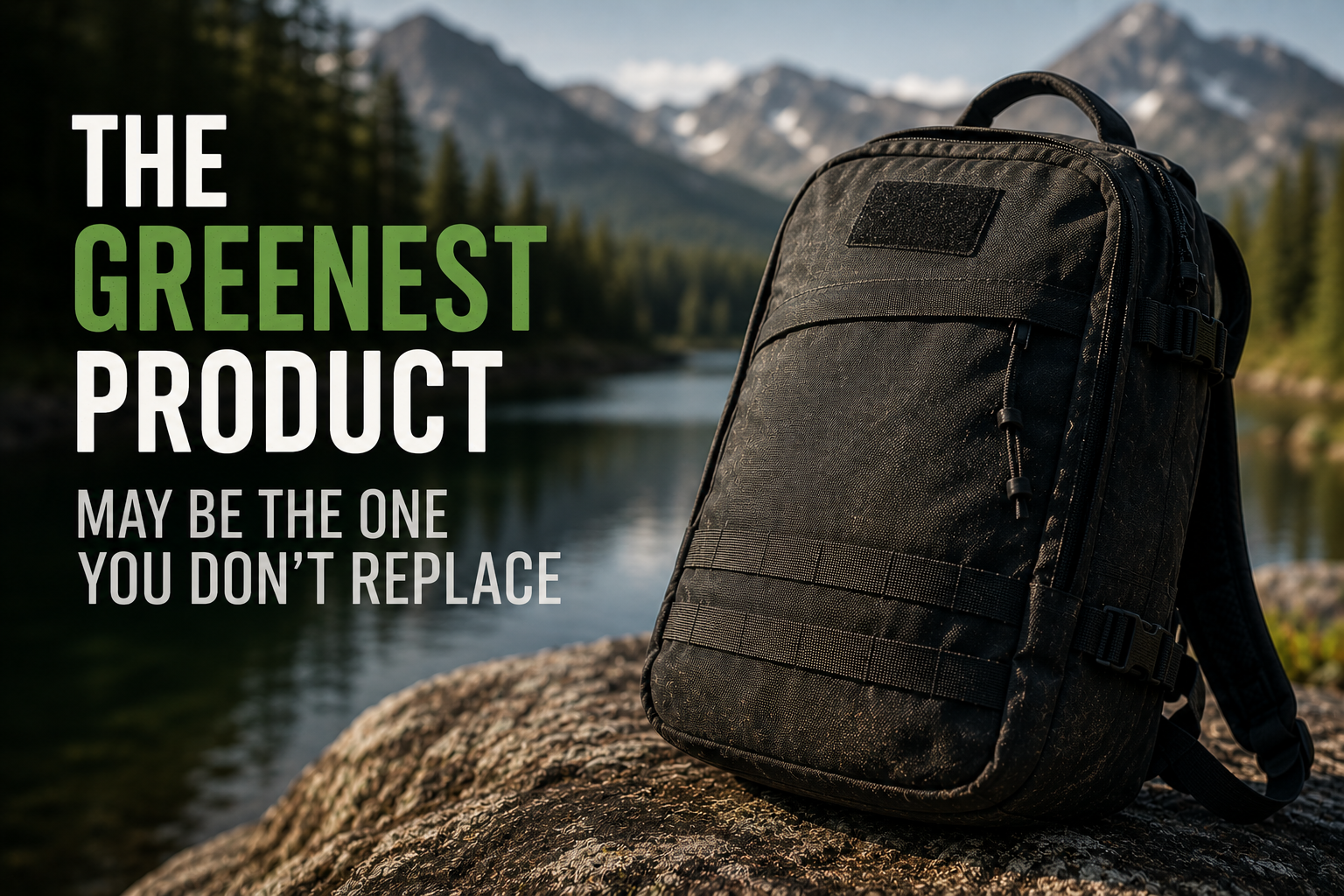
The greenest product may be the one you do not replace
We talk a lot about what products are made of.
We talk far less about how long they last.
That is a gap in how we think about environmental responsibility.
Most sustainability conversations focus on inputs.
Is the product recycled? Is the dye cleaner? Are the chemicals safer? Is the packaging reduced?
Those questions matter. But they are not the whole story.
I recently read a perspective from GORUCK founder Jason McCarthy that made me think about sustainability differently. His point was practical: environmentalism can also come from building something properly the first time, repairing it when needed and keeping it out of landfills as long as possible.
That idea aligned with a practical lesson from my own life.
When I began rucking, a standard backpack proved inadequate. Carrying heavy loads safely requires equipment designed for that purpose, not a bag designed mainly to transport a laptop.
The lesson was simple: for demanding use, durability is not a luxury. It is a requirement.
That is where the environmental argument becomes real.
We often feel better buying the “green” alternative, even if we know we may replace it in a few years. The product may have better inputs, but if it fails quickly, the environmental benefit falls short.
A recycled product that breaks and is discarded is still waste.
A durable product that stays in service tells a different story.
This is not about one company or one backpack. It is about a broader consumer habit.
We have been trained to look for newer, lighter, cheaper and more convenient. We have not been trained as well to ask whether something will last, whether it can be repaired and whether it will prevent another purchase later.
True sustainability is not only found in the recycling bin. It is also found in the absence of a replacement.
A product’s environmental impact should not be measured only by what it is made from. It should also be measured by how long it lasts.
Can it be repaired?
Does it prevent repeated purchases of the same type of product?
There is also an economic argument inside the environmental one.
A high-quality item may look expensive on day one. But if it lasts 10 years, the cost per year becomes much more reasonable.
By contrast, a cheaper product that fails every two years may cost the same or more over time. It also creates repeated waste.
This is not an argument that every consumer must purchase premium gear. Many people cannot, and many use cases do not require it. It is an argument that durability should be part of how we define sustainability.
Repair matters here.
A broken zipper, torn seam or damaged panel should not automatically mean a product is finished. In many cases, repair can return it to service.
That matters because repair is a quiet act of resistance against the discard economy.
Modern consumer markets are often engineered around replacement. New versions, seasonal changes and cosmetic updates encourage people to treat yesterday’s perfectly functional product as obsolete.
That mindset deserves more scrutiny.
We should not always see wear as failure. Sometimes wear is proof that a product is doing its job.
There is an important balance here. Recycled materials, cleaner chemistry and better manufacturing practices still matter. Durability is not a free pass to ignore environmental inputs or supply-chain impact.
But longevity deserves a more prominent place in the sustainability conversation.
For products such as bags, clothing and everyday tools, the logic is practical. These items do not consume energy while being used. Much of their environmental impact comes from materials, manufacturing, shipping and disposal.
If one well-built product prevents several weaker products from being made, shipped and discarded, that is a meaningful outcome.
The best version of environmentalism is not performative. It is practical.
It means buying fewer things where possible, choosing durability when it matters, repairing what can be repaired and keeping useful products in service longer.
Quality is not only a product attribute.
In the right context, quality is an environmental strategy.
Disclosure and disclaimer
This article reflects my personal views and does not represent the views, policies or positions of my employer, clients, partners or any affiliated organization. I purchased my rucking and everyday carry products with personal funds. This post is not sponsored and no compensation, free product or exchange of value was involved. I may have used generative AI tools to assist with research and editing. All conclusions and final editorial decisions are my own.
This article is for general informational purposes only and does not constitute legal, financial, investment, security, privacy, tax, accounting, environmental or other professional advice. Readers should verify current information and seek appropriate professional advice before making decisions.
Keywords: #Sustainability #CircularEconomy #Durability #Repairability #ResponsibleConsumption #ProductLongevity #BuyLess #ChooseQuality #SustainableDesign #SustainableBusiness #EnvironmentalResponsibility #WasteReduction #LandfillReduction #RightToRepair #ConsciousConsumerism #QualityMatters #LifecycleThinking #CorporateResponsibility #SupplyChain #ESG #ClimateAction #Rucking #EverydayCarry #OutdoorGear #ProductDesign #BusinessLeadership #ThoughtLeadership #CanadianBusiness #PracticalSustainability #CircularDesign