
The Art of the Gray Man: How to Travel Smart, Stay Safe, and Experience More of the World
“Travel is fatal to prejudice, bigotry, and narrow-mindedness.”
— Mark Twain
Travel changes how we see the world.
It exposes us to new cultures, unfamiliar environments, and perspectives that challenge our assumptions. But the moment you leave home, one fundamental reality shifts:
You are playing an away game.
Different social norms. Different systems. Different risks.
You do not need to be paranoid when you travel.
You need to be deliberate.
Security professionals often use a concept known as the gray man. The philosophy is simple: blend into your environment so completely that you never attract attention in the first place.
The goal is not to hide.
The goal is to be so unremarkable that no one remembers you.
Most criminals are not looking for confrontation. They are looking for opportunity — someone distracted, uncertain, or visibly out of place.
The gray man approach simply removes that opportunity.
EmDash challenges the way WordPress has been secured
Cloudflare has introduced EmDash as a spiritual successor to WordPress. That is the headline. The more important issue is the architecture behind it.
For years, WordPress has balanced flexibility and scale against a plugin model built on a high degree of trust. That trade-off helped make it the dominant publishing platform on the web. It also contributed to one of its most persistent security weaknesses.
Why Gas Prices Drop in the Evening
If you live in Ontario, you have likely noticed it: the price at your local station in the morning looks one way, and by the time you drive past after work, it is often several cents per litre lower. It is not a promotion, not a glitch and not your imagination. In competitive Ontario markets, it is a recognizable pattern — and the explanation is more commercial than mysterious.
Personas in AI, friend or foe?
Are you using persona prompts with AI? Here’s what the research actually says.
A new study from USC (“Expert Personas Improve LLM Alignment but Damage Accuracy”) tested expert persona prompts across six large language models and finally explains why the community has seen such mixed results.
The finding is simple but important: persona prompts are an alignment tool, not a knowledge tool.
When personas HELP: → Writing tone and style (scores jumped from 7/10 to 9/10 on professional email drafting) → Safety and refusal (jailbreak resistance improved by up to 17.7%) → Format adherence, structured output, and intent following → Longer, more detailed persona descriptions amplify these gains
When personas HURT: → Factual accuracy and knowledge retrieval (accuracy dropped from 71.6% to 68.0%) → Math and logical reasoning (one example went from 9/10 to 1.5/10) → Coding tasks requiring precise recall → Longer personas make the damage worse
Five things you can do right now:
-
Use personas for creative, editorial, and compliance-sensitive tasks. Drop them for factual lookups, calculations, and code logic.
-
Place personas in the system prompt, not the user message — it matters on well-optimized models.
-
If you’re using reasoning models (like DeepSeek R1), skip expert personas entirely. The research shows a random persona works just as well — the model only benefits from added context length, not expertise.
-
For safety hardening, a dedicated “safety monitor” persona in the system prompt is one of the cheapest and most effective interventions available.
-
When you must use a persona on accuracy-sensitive work, keep it as short as possible to minimize interference with factual recall.
The bottom line: treat persona prompts like a tone and alignment amplifier, not a knowledge enhancer. Knowing when to use them — and when to strip them out — is a real competitive advantage.
Paper: “Expert Personas Improve LLM Alignment but Damage Accuracy: Bootstrapping Intent-Based Persona Routing with PRISM” (Hu, Rostami, Thomason — USC, 2026)
CodeWall says it hacked McKinsey’s AI platform. Here’s what holds up — and what doesn’t.
This reflects my personal assessment of publicly available reporting and CodeWall’s published blog post. I was not involved in the testing, I do not have access to McKinsey’s internal facts or forensic findings, and my views should be read as commentary and opinion rather than statements of verified fact.
A security startup called CodeWall claims its autonomous agent compromised McKinsey’s internal AI platform, Lilli, within two hours and gained unauthenticated read-write access to a production database containing tens of millions of consultant conversations. The vulnerability appears credible. The claimed scope of impact is not fully evidenced. The primary CodeWall post is here: codewall.ai/blog/how-… Independent reporting by Jessica Lyons in The Register is here: www.theregister.com/2026/03/0…
DeerFlow 2.0: ByteDance’s open-source AI agent harness for research and software tasks
DeerFlow 2.0, an open-source project from ByteDance, has quickly become one of the most visible AI agent releases of early 2026. The project’s public repository says it reached No. 1 on GitHub Trending on Feb. 28, 2026, and the repository currently shows about 25,000 stars and 3,000 forks. For teams evaluating agentic systems, DeerFlow deserves attention, but it also warrants disciplined review.
Heretic and the new reality of modifiable AI safety
Open-source large language models have made advanced generative AI broadly accessible. What is changing now is not only model capability, but the ease with which model behaviour can be altered after release — including behaviour that vendors and labs describe as “safety alignment.”
One of the most visible examples is Heretic, an open-source project that automates the removal of refusal behaviour in transformer-based language models. The project is not subtle about its purpose. It describes itself as “fully automatic censorship removal,” and it is gaining traction quickly.
This post does not provide instructions for disabling safeguards. Instead, it focuses on what is verifiably true about the tool, the research it is built on, and why this matters for security leaders, developers and governance teams.
Are Dorsey’s giant job cuts the start of an AI jobs apocalypse? Economists weigh in
Block CEO Jack Dorsey’s decision to cut nearly half the company’s workforce raises questions about AI’s impact on jobs, but economists suggest this is a company-specific adjustment rather than a sign of a broader labor market shift. While AI may disrupt some jobs, experts like Claudia Sahm emphasize that it doesn’t necessarily lead to mass layoffs, and other economists believe AI will enhance productivity by changing workflows rather than eliminating jobs outright.
Your encrypted email is a neon sign: applying the grey man principle to digital privacy
Every security blog, podcast and YouTube channel gives you the same advice. Use ProtonMail. Switch to Signal. Route everything through Tor. Encrypt your hard drive. The message is always the same: encrypt everything and you will be safe.
I have spent more than 25 years in cybersecurity. I have built intelligence platforms for government agencies and I run security operations for a global enterprise. And I am going to tell you something most privacy guides will not: by following that advice to the letter, you may be making yourself a target instead of protecting yourself.
Speedtest® Connectivity Report | Canada H2 2025
The Speedtest Connectivity Report for Canada H2 2025 reveals Bell as the leader in 5G performance, offering the fastest 5G speeds and best mobile gaming and video experiences. Bell pure fibre also dominated the fixed broadband market, recognized as the fastest and top-rated ISP with the best gaming experience. Rogers excelled in mobile video experience and 5G availability, while TELUS was noted for the most consistent mobile network.
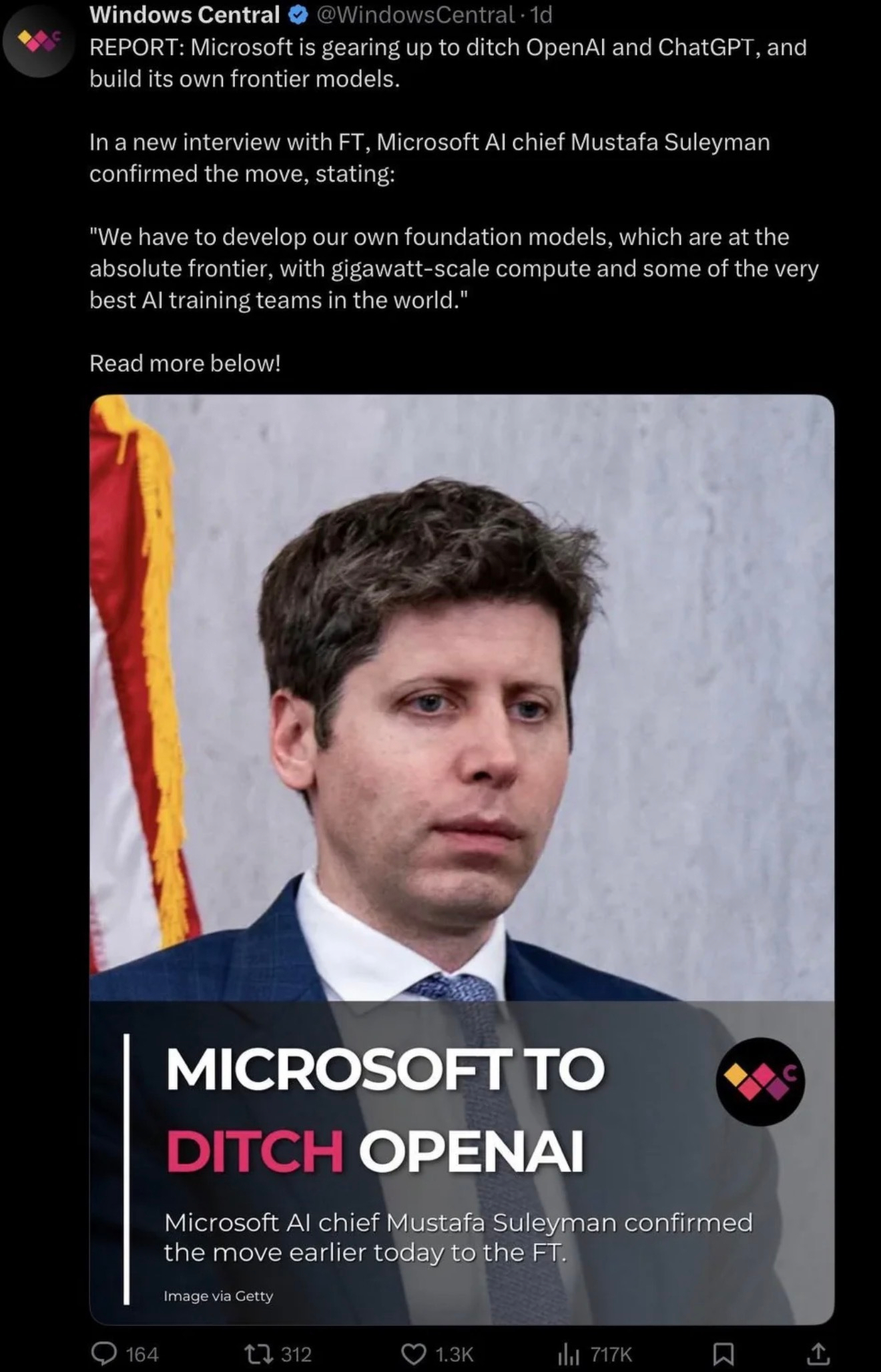
The Era of AI Self-Sufficiency: Microsoft’s Strategic Pivot
The headlines saying Microsoft is “ditching” OpenAI are a bit sensationalist, but the underlying shift is very real. Microsoft AI CEO Mustafa Suleyman recently confirmed a major move toward developing in-house foundation models.
The Reality: Microsoft isn’t walking away from its 27% stake in OpenAI. Instead, they are moving toward “True AI Self-Sufficiency.” By building their own frontier models (like the rumored MAI-1) with gigawatt-scale compute, Microsoft is reducing its dependency on a single partner.
Why this matters:
• Diversification: Microsoft is now hosting models from Meta, Mistral, and Anthropic. • Cost Efficiency: Running in-house models at scale is far more sustainable than paying API margins for every Copilot query. • Competition: In 2026, the “moat” isn’t just the model—it’s the compute and the data.
The Microsoft-OpenAI partnership is evolving from “exclusive dependency” to “strategic alliance.” It’s a masterclass in how a tech giant scales: Partner to lead, then build to own.
#AI #TechStrategy #Microsoft #OpenAI #FutureOfWork #CloudComputing
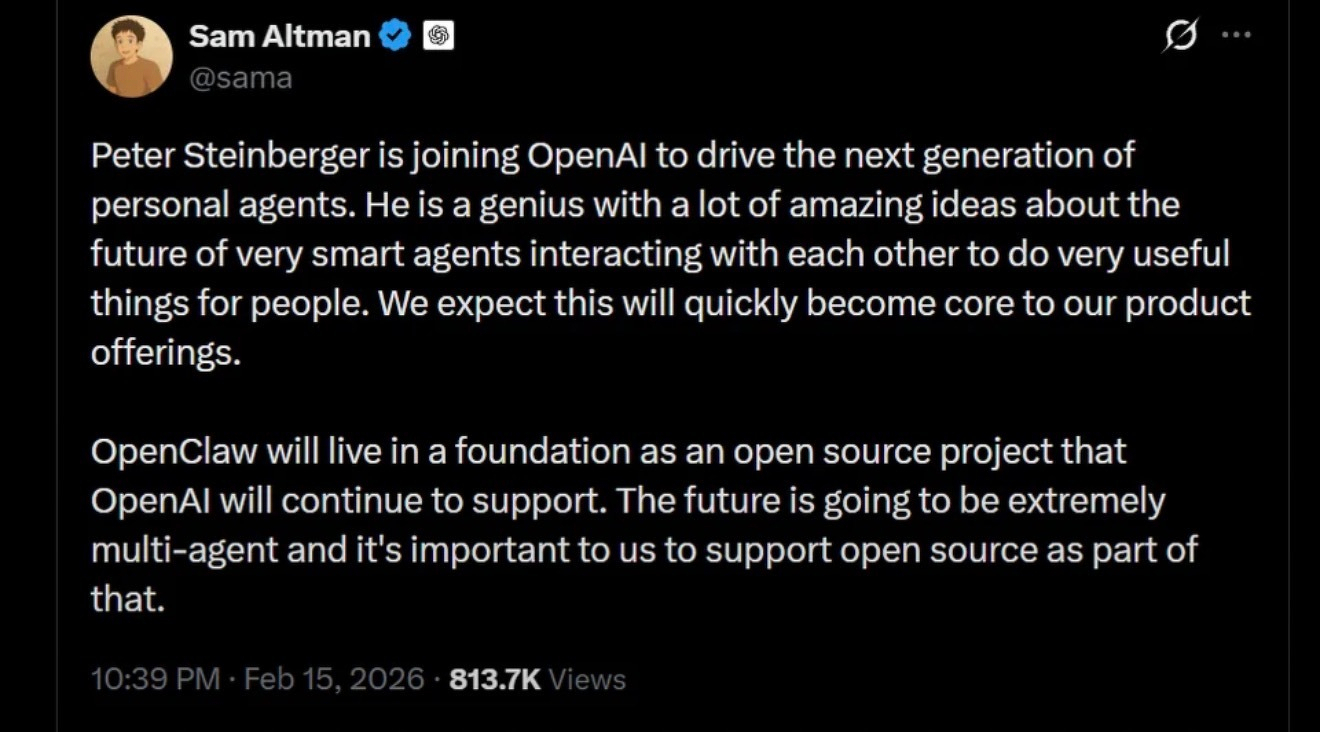
A Massive Shift for AI Agents: Peter Steinberger Joins OpenAI
Big news in the AI agent space today. Sam Altman just announced that Peter Steinberger is joining OpenAI to lead the next generation of personal agents. For those who don’t know the background here, Peter is a veteran engineer and entrepreneur who founded and successfully exited PSPDFKit. He has recently been focused on building “OpenClaw,” an agent framework designed to execute complex tasks rather than just outputting text. This move signals two major things for the industry:
- OpenAI is doubling down on “Action” Agents. By bringing Peter on board, they are prioritizing agents that can navigate the web and perform useful work, a future Sam describes as “extremely multi-agent.”
- Open Source Support. The announcement confirms that OpenClaw will transition to a foundation and remain open source with OpenAI’s support, rather than being closed off.
It looks like the era of agents interacting with other agents to get work done is officially becoming a core product focus.
#OpenAI #ArtificialIntelligence #TechNews #OpenClaw #AIAgents
Outsourced Intelligence: The Hidden Attack Surface in Enterprise AI
When outsourced AI makes a bad call, distinguishing technical error from deliberate compromise becomes critical.
Cloudflare 1.1.1.1 with WARP: What it does and how it differs from a VPN
Cloudflare’s 1.1.1.1 with WARP resembles a virtual private network (VPN) in practice, acting as a secure tunnel and installing using the operating system’s VPN framework on many devices. Yet Cloudflare often resists the label, describing the service in its documentation as a free app intended to improve privacy and security. For IT professionals and privacy-conscious consumers, this is not just a matter of terminology. The technical architecture beneath the app fundamentally changes the privacy guarantees, the utility for bypassing geographic restrictions and the underlying security posture of the device.
Choosing the right tool for the job requires a clear understanding of your requirements and your threat model. In practical terms, the same “connect” button can support very different outcomes depending on whether you need confidentiality on public Wi-Fi, location shifting for streaming, or reduced trust in the provider operating the tunnel.
This analysis provides a decision framework for deploying these tools based on technical mechanics, strengths and limitations.
- If you need speed and straightforward encryption on public Wi-Fi, use WARP.
- If you need exit-country selection and geo-unblocking, use a commercial VPN.
- If you require provider anonymity and a minimized trust model, prefer a VPN supported by independent assurance and anonymous payment options.
AI on Australian travel company website sends tourists to nonexistent hot springs | CNN
An AI-generated blog on the Tasmania Tours website recommended nonexistent hot springs in Weldborough, Tasmania, leading tourists to search for them in vain. The tour company owner admitted the AI “messed up completely”, while a local hotel owner confirmed tourists were arriving in droves looking for the phantom springs.
Tired of sifting through 47 security newsletters?
I do it for you.
Every morning I publish 10-15 handpicked threat intel stories at threatintel.cc — zero automation, zero fluff. Curated by a CISO who actually reads the research.
No spam. No BS. Just signal.
Free daily digest: threatintel.cc

The Demographic Crossroads: Understanding Natural Population Decline
TL;DR
Many advanced and emerging economies are now experiencing natural population decline, where deaths exceed births, driven by sustained below-replacement fertility and population aging. While immigration has offset these declines in some countries, demographic momentum points to long-term economic, fiscal and labour market challenges that policy interventions have so far struggled to reverse.
In 2025, France recorded more deaths than births for the first time since the end of the Second World War, crossing a demographic threshold that marks a shift in the country’s population dynamics. According to data released by INSEE (Institut National de la Statistique et des Études Économiques), France recorded 645,000 births and 651,000 deaths in 2025, resulting in a negative natural balance of 6,000.
Despite this milestone, France’s total population continued to grow modestly. As of Jan. 1, 2026, France’s population stood at 69.1 million, a 0.25 per cent increase from the previous year. This growth was driven entirely by net migration, provisionally estimated at 176,000 people. France’s total fertility rate in 2025 was 1.56 children per woman, the lowest level since the end of the First World War and well below the replacement level, commonly estimated at about 2.1 children per woman in high-income countries.
Why there is no such thing as a “hack-proof” phone — and why that is OK
I recently watched a viral video promoting a “privacy-first” smartphone. It is a compelling watch and it introduces useful operational security ideas. This post is not a critique of the creator or the product. It is a practical counterpoint from the perspective of a security professional, written to help non-specialists separate what is real, what is hype, and where nuance matters. The video discussed in this article is publicly available here: youtu.be/FR-zQXxcu…
In cybersecurity, absolute claims are a warning sign. “Untrackable.” “Government-proof.” “Unhackable.” Real-world security does not work that way. Security is always a set of trade-offs across privacy, security and usability, and the right choice depends on your threat model — what you are trying to protect, from whom, and at what cost.
The end of the ‘stochastic parrot’: Why AI’s latest breakthrough demands a new executive mindset
For years, skeptics of artificial intelligence had a comfortable safety net. They described AI as a “stochastic parrot” — a term coined by linguist Emily M. Bender to define systems that merely predict the next word based on statistical patterns. The consensus was clear: AI could remix the past, but it could never discover. It lacked the spark of original thought required to solve problems humanity had not already cracked.
On Jan. 6, 2026, the global mathematical community clarified the constraints of a long-running mystery known as Erdős Problem #728. Within days, a research team published a resolution on arXiv (Jan. 12, 2026) that dismantled the “parrot” argument for good.
Winter storm updates: Ice, snow storm set to unleash dangerous impacts for 200M
Governors across more than a dozen states have issued states of emergencies due to the largest winter storm of the season, which is expected to impact 200 million people from Texas to the Northeast with snow, ice, and dangerous cold. States like Oklahoma have activated the National Guard, while others are seeing shelves empty as residents stock up on essentials.