
The Era of AI Self-Sufficiency: Microsoft’s Strategic Pivot
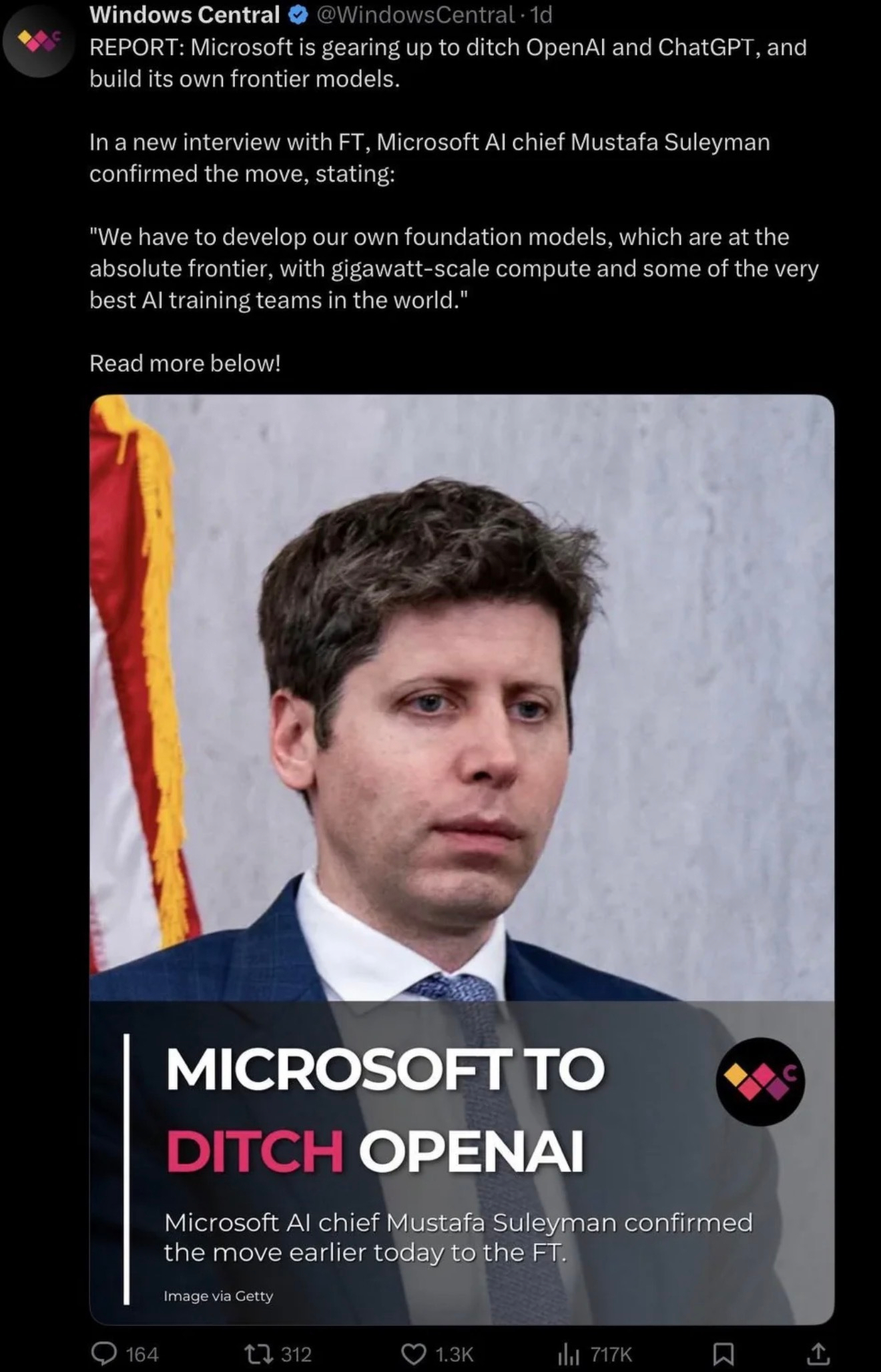
The headlines saying Microsoft is “ditching” OpenAI are a bit sensationalist, but the underlying shift is very real. Microsoft AI CEO Mustafa Suleyman recently confirmed a major move toward developing in-house foundation models.
The Reality: Microsoft isn’t walking away from its 27% stake in OpenAI. Instead, they are moving toward “True AI Self-Sufficiency.” By building their own frontier models (like the rumored MAI-1) with gigawatt-scale compute, Microsoft is reducing its dependency on a single partner.
Why this matters:
• Diversification: Microsoft is now hosting models from Meta, Mistral, and Anthropic. • Cost Efficiency: Running in-house models at scale is far more sustainable than paying API margins for every Copilot query. • Competition: In 2026, the “moat” isn’t just the model—it’s the compute and the data.
The Microsoft-OpenAI partnership is evolving from “exclusive dependency” to “strategic alliance.” It’s a masterclass in how a tech giant scales: Partner to lead, then build to own.
#AI #TechStrategy #Microsoft #OpenAI #FutureOfWork #CloudComputing
A Massive Shift for AI Agents: Peter Steinberger Joins OpenAI
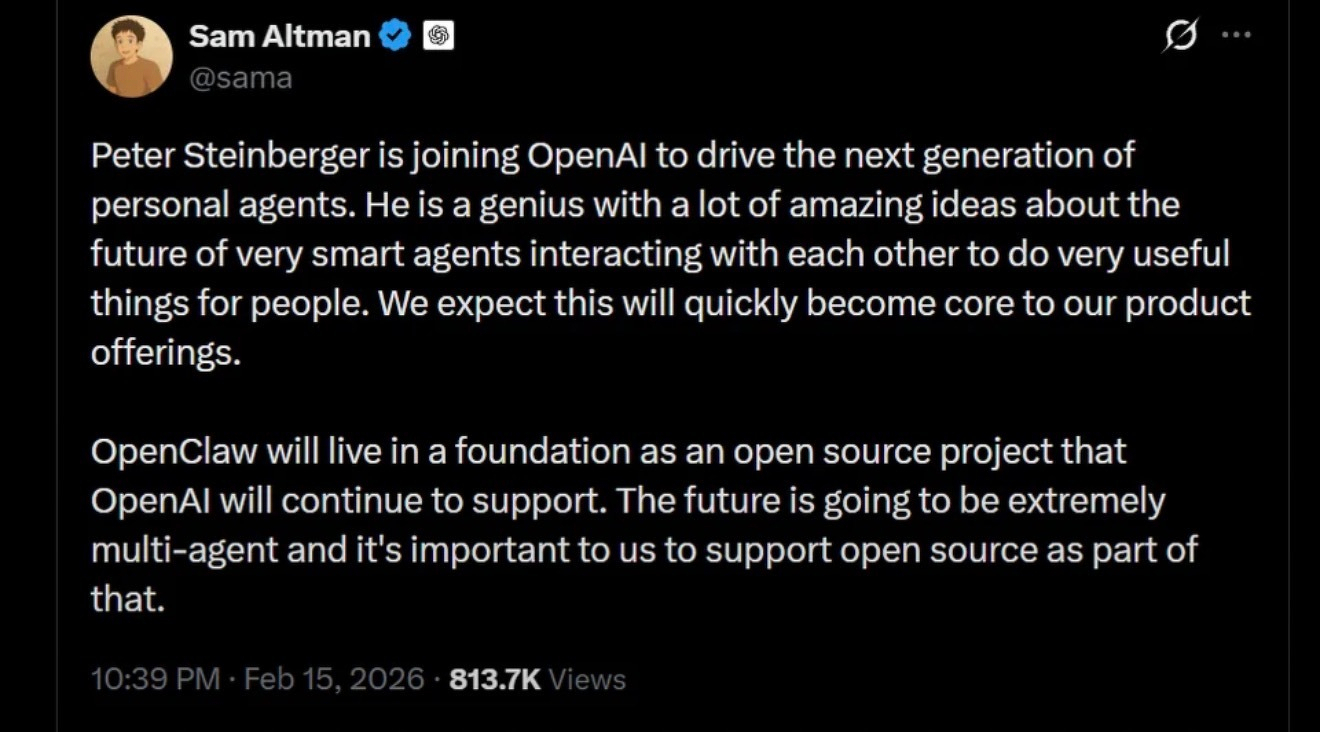
Big news in the AI agent space today. Sam Altman just announced that Peter Steinberger is joining OpenAI to lead the next generation of personal agents. For those who don’t know the background here, Peter is a veteran engineer and entrepreneur who founded and successfully exited PSPDFKit. He has recently been focused on building “OpenClaw,” an agent framework designed to execute complex tasks rather than just outputting text. This move signals two major things for the industry:
- OpenAI is doubling down on “Action” Agents. By bringing Peter on board, they are prioritizing agents that can navigate the web and perform useful work, a future Sam describes as “extremely multi-agent.”
- Open Source Support. The announcement confirms that OpenClaw will transition to a foundation and remain open source with OpenAI’s support, rather than being closed off.
It looks like the era of agents interacting with other agents to get work done is officially becoming a core product focus.
#OpenAI #ArtificialIntelligence #TechNews #OpenClaw #AIAgents
Outsourced Intelligence: The Hidden Attack Surface in Enterprise AI
When outsourced AI makes a bad call, distinguishing technical error from deliberate compromise becomes critical.
Cloudflare 1.1.1.1 with WARP: What it does and how it differs from a VPN
Cloudflare’s 1.1.1.1 with WARP resembles a virtual private network (VPN) in practice, acting as a secure tunnel and installing using the operating system’s VPN framework on many devices. Yet Cloudflare often resists the label, describing the service in its documentation as a free app intended to improve privacy and security. For IT professionals and privacy-conscious consumers, this is not just a matter of terminology. The technical architecture beneath the app fundamentally changes the privacy guarantees, the utility for bypassing geographic restrictions and the underlying security posture of the device.
Choosing the right tool for the job requires a clear understanding of your requirements and your threat model. In practical terms, the same “connect” button can support very different outcomes depending on whether you need confidentiality on public Wi-Fi, location shifting for streaming, or reduced trust in the provider operating the tunnel.
This analysis provides a decision framework for deploying these tools based on technical mechanics, strengths and limitations.
- If you need speed and straightforward encryption on public Wi-Fi, use WARP.
- If you need exit-country selection and geo-unblocking, use a commercial VPN.
- If you require provider anonymity and a minimized trust model, prefer a VPN supported by independent assurance and anonymous payment options.
AI on Australian travel company website sends tourists to nonexistent hot springs | CNN
An AI-generated blog on the Tasmania Tours website recommended nonexistent hot springs in Weldborough, Tasmania, leading tourists to search for them in vain. The tour company owner admitted the AI “messed up completely”, while a local hotel owner confirmed tourists were arriving in droves looking for the phantom springs.
Tired of sifting through 47 security newsletters?
I do it for you.
Every morning I publish 10-15 handpicked threat intel stories at threatintel.cc — zero automation, zero fluff. Curated by a CISO who actually reads the research.
No spam. No BS. Just signal.
Free daily digest: threatintel.cc

The Demographic Crossroads: Understanding Natural Population Decline
TL;DR
Many advanced and emerging economies are now experiencing natural population decline, where deaths exceed births, driven by sustained below-replacement fertility and population aging. While immigration has offset these declines in some countries, demographic momentum points to long-term economic, fiscal and labour market challenges that policy interventions have so far struggled to reverse.
In 2025, France recorded more deaths than births for the first time since the end of the Second World War, crossing a demographic threshold that marks a shift in the country’s population dynamics. According to data released by INSEE (Institut National de la Statistique et des Études Économiques), France recorded 645,000 births and 651,000 deaths in 2025, resulting in a negative natural balance of 6,000.
Despite this milestone, France’s total population continued to grow modestly. As of Jan. 1, 2026, France’s population stood at 69.1 million, a 0.25 per cent increase from the previous year. This growth was driven entirely by net migration, provisionally estimated at 176,000 people. France’s total fertility rate in 2025 was 1.56 children per woman, the lowest level since the end of the First World War and well below the replacement level, commonly estimated at about 2.1 children per woman in high-income countries.
Why there is no such thing as a “hack-proof” phone — and why that is OK
I recently watched a viral video promoting a “privacy-first” smartphone. It is a compelling watch and it introduces useful operational security ideas. This post is not a critique of the creator or the product. It is a practical counterpoint from the perspective of a security professional, written to help non-specialists separate what is real, what is hype, and where nuance matters. The video discussed in this article is publicly available here: youtu.be/FR-zQXxcu…
In cybersecurity, absolute claims are a warning sign. “Untrackable.” “Government-proof.” “Unhackable.” Real-world security does not work that way. Security is always a set of trade-offs across privacy, security and usability, and the right choice depends on your threat model — what you are trying to protect, from whom, and at what cost.
The end of the ‘stochastic parrot’: Why AI’s latest breakthrough demands a new executive mindset
For years, skeptics of artificial intelligence had a comfortable safety net. They described AI as a “stochastic parrot” — a term coined by linguist Emily M. Bender to define systems that merely predict the next word based on statistical patterns. The consensus was clear: AI could remix the past, but it could never discover. It lacked the spark of original thought required to solve problems humanity had not already cracked.
On Jan. 6, 2026, the global mathematical community clarified the constraints of a long-running mystery known as Erdős Problem #728. Within days, a research team published a resolution on arXiv (Jan. 12, 2026) that dismantled the “parrot” argument for good.
Winter storm updates: Ice, snow storm set to unleash dangerous impacts for 200M
Governors across more than a dozen states have issued states of emergencies due to the largest winter storm of the season, which is expected to impact 200 million people from Texas to the Northeast with snow, ice, and dangerous cold. States like Oklahoma have activated the National Guard, while others are seeing shelves empty as residents stock up on essentials.
Free threat intel feed with links & summaries in one clean spot. Access via RSS, JSON, Fediverse, or web—your choice. No registration, no vendor spam. Just curated intelligence for defenders. threatintel.cc #ThreatIntel #InfoSec
USPS Network Changes: What's Affecting Your Shipments Right Now
If you’ve noticed slower delivery times and unusual tracking behaviour for U.S. mail in early 2026, you’re not alone. Several major operational changes took effect in late 2025 and early 2026 that are directly impacting cross-border shipments between Canada and the United States.
'Contested Information Environment': A Field Manual for Tactical Information Integrity
In 2026, the internet often functions less like a public square and more like a contested information environment. As a senior analyst with 20 years in counter-disinformation, I view digital interaction in high-engagement spaces not merely as social exchange, but as a tactical manoeuvre within a broader battlespace. If you are not actively auditing your intake, you are not a consumer—you are a target.
Google supercharges Gemini API with massive file limits and cloud storage integration
Google has supercharged its Gemini API by significantly increasing file size limits to 100MB and integrating with Google Cloud Storage, AWS S3, and Azure Blob Storage via HTTPS and Signed URLs. These updates, powered by Gemini 3 models, aim to simplify data ingestion for developers building large-scale multimodal AI applications.
SWISS introduces new rules for power banks on board
SWISS introduces new in-flight rules for power banks (effective Jan. 15)
SWISS and the Lufthansa Group have announced updated safety rules for carrying and using power banks on board, aligned with guidance from EASA, FAA, IATA and ICAO.
What’s changing • Maximum of two power banks per passenger • No charging devices from a power bank during the flight • No charging power banks from aircraft power • No overhead bin storage — power banks must stay on your person, in the seat pocket or under the seat • Not permitted in checked baggage • Up to 100 Wh allowed • 100–160 Wh only with prior airline approval • Continued use permitted for essential medical devices • The same rules apply to e-cigarettes
Why this matters Power banks contain lithium batteries, which can pose a fire risk if they malfunction. Keeping them accessible and limiting use reduces risk to passengers and crew.
What travellers should do Plan to board with devices fully charged, check the watt-hour rating of your power banks, and request airline approval in advance if carrying higher-capacity units.
Anthropic launches Cowork, a file-managing AI agent that could threaten dozens of startups | Fortune
Anthropic has launched Claude Cowork, an AI agent capable of manipulating, reading, and analyzing files on a user’s computer, designed for non-technical users. This new tool, an evolution of Claude Code, aims to compete in the enterprise AI race by offering autonomous work capabilities, though it raises security concerns and poses a competitive threat to AI startups.
It’s getting harder to find a job in Toronto even if you have a degree
Toronto’s job market has tightened significantly, leaving many graduates and experienced professionals unable to secure interviews or full-time work, even for entry-level roles. Youth are most affected, with one in four young people in Toronto looking for work, as Ontario’s unemployment rate reached 7 per cent in 2025 — the highest outside the pandemic since the 1990s.
Highly educated candidates, including those with MBAs and PhDs, report applying to hundreds of jobs without success, prompting some to consider leaving Ontario. Job losses are concentrated in manufacturing, construction, film and television, and post-secondary education, though policymakers remain cautiously optimistic that infrastructure and public service investment could support recovery.
A Golden Bonus: Dreame Technology’s Creative Way to Celebrate Success
What if your year-end bonus included a piece of actual gold?
The happiness dividend: Why well-being predicts career success
For decades, conventional wisdom about career advancement followed a linear path: work harder, achieve success and you will eventually be happy.
However, a robust body of peer-reviewed research is challenging that narrative. Evidence from longitudinal studies and experimental trials suggests happiness is not merely the reward for a successful career — it is often a predictor of it.
Research suggests that individuals with high positive affect — the psychological term for cheerfulness and life satisfaction — are more likely to be hired, receive stronger performance evaluations and earn higher incomes in early adulthood and beyond.
From clicks to intent: How the Universal Commerce Protocol is quietly rewriting e-commerce
We have optimized clicks for decades, yet online shopping remains rife with friction. Consumers still juggle multiple tabs, forgotten passwords and repeated entry of shipping information for the tenth time. Despite real progress in user experience design, e-commerce is still a fragmented journey.